
The Benefits of Gratitude: What the Research Really Says
More optimism, stronger relationships, a kinder view of your day: what research really says about the benefits of gratitude, and how to practice it.
Published on November 11, 2026 · 5 min read

In several studies, gratitude is linked to more optimism, greater life satisfaction, more frequent positive emotions and stronger relationships. It isn't a magic wand or a treatment: it's a simple habit that helps you notice what's going well. Here's what the research really says, what it doesn't say, and how to bring gratitude into your everyday life.
What is gratitude, exactly?
Gratitude means recognizing the good in your life and understanding that some of it comes from outside yourself: other people, nature, a lucky turn of events. Robert Emmons of the University of California, Davis, one of the best-known researchers on the subject, describes it as learning to see good things as gifts rather than as something we're owed.
It's both a feeling (the warmth you get when someone helps you) and a practice (deliberately taking time to notice and name what's good). It's the practice that researchers study.
What the studies show (read with care)
More optimism and a kinder view of life
In a widely cited study, Robert Emmons and Michael McCullough (University of Miami) asked participants to write a few sentences each week. One group wrote about things they were grateful for, another about daily irritations, a third about neutral events. After 10 weeks, the gratitude group reported feeling more optimistic and better about their lives, as Harvard Health Publishing summarizes.
A real lift when you thank someone directly
Psychologist Martin Seligman (University of Pennsylvania) compared several positive psychology exercises. Writing a gratitude letter to someone who had never been properly thanked, then delivering it in person, produced the largest increase in happiness scores. The effect lasted about a month, then faded, which is why researchers suggest repeating the exercise regularly rather than doing it once.
Three good things a day
In another 2005 study by Seligman's team, people who wrote down three things that went well each evening for one week, and why, reported more happiness up to six months later. The Greater Good Science Center at UC Berkeley presents this as one of the easiest gratitude practices to try.
Stronger connections with others
Saying thank you reminds others that they matter, and reminds you that you've been helped. Berkeley researchers note that expressing gratitude directly to someone strengthens your sense of connection with them.
A recent study on gratitude and longevity
In 2024, a study published in JAMA Psychiatry followed nearly 49,000 older American nurses with an average age of 79. Those with the highest gratitude scores had a somewhat lower risk of dying over the next four years. The lead researcher, Tyler VanderWeele of Harvard, called the difference "meaningful, but not huge."
What the research doesn't say
Being honest matters, and that's how we do things at Lantern Days:
- An association isn't proof. Most of these studies show a link between gratitude and well-being, not that gratitude causes it. Harvard Health says so clearly.
- The samples are limited. Many studies involved mostly educated American adults; the 2024 study looked at older female nurses. We don't know whether the results hold for everyone.
- Effects vary across cultures. The Greater Good Science Center notes that in some studies, participants felt a bit of guilt or indebtedness after writing a gratitude letter. It's not a one-size-fits-all exercise.
- Gratitude doesn't replace professional help. If you're dealing with depression, anxiety or difficult grief, gratitude can be a small support, never a treatment.
Bottom line: gratitude is a gentle, free and accessible habit that seems to help many people feel better. That's already a lot.
The benefits you notice day to day
Beyond the studies, here's what the practice tends to change in an ordinary day, based on what researchers and practitioners describe:
- Your attention shifts. Our brains notice problems more easily than what's going right. Writing down what you're grateful for trains you to see the rest too.
- You savor more. When you know you'll write tonight, you notice small moments during the day.
- You feel less alone. Naming the people who help you reminds you that you're part of a network, even a small one.
- You end the day on a calmer note. For many people, reviewing three good moments before bed replaces endless scrolling.
- You keep a record. Rereading your thank-yous months later reminds you of everything that was good, even in a hard year.
How to practice gratitude every day
You don't need much time. Pick one or two practices and stick with them for a few weeks:
- Three good things: each evening, write down three things that went well and why.
- Gratitude journal: once or twice a week, describe in detail up to five things or people you're grateful for.
- Gratitude letter: every so often, write to someone you've never properly thanked.
- Mental subtraction: imagine your life without a happy event (a meeting, a job) to feel its value more clearly.
- Dinner-table gratitude: everyone shares one good moment from their day.
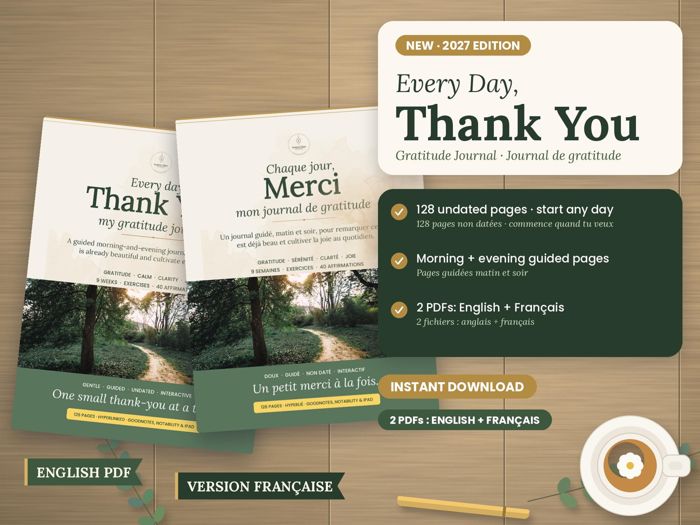
A guided journal takes away the "what do I write?" problem and helps you keep going. That's why we created Every Day, Thank You: a gentle prompt each day, room for three specific thank-yous, and reflection pages.
When gratitude feels impossible
During grief, illness or a very heavy season, "just be grateful" can sound like a reproach. That's not the message. Gratitude never asks you to deny your pain. You can write both what hurts and what helps a little: a friend, a hot meal, a moment of rest. And if even that is too much, it's completely okay to set the practice aside.
If your sadness lingers, keeps you from functioning, or you have dark thoughts, talk to someone you trust or a professional.
Frequently asked questions
How long does it take to feel the benefits of gratitude?
It varies. In studies, exercises often lasted from one to ten weeks. Many people notice a shift in how they see their day after a few weeks of regular practice. The key is to keep going without pressure.
Does gratitude really make you happier?
Research shows a frequent link between gratitude and well-being, and some exercises raised the happiness levels participants reported. But it's not a guarantee, and effects differ from person to person.
Is it better to practice gratitude in the morning or at night?
Both work. Three good things is often done before bed, but choose the time you're most likely to stick with.
Can gratitude replace therapy?
No. It's a well-being habit, not a treatment. If you're in distress, professional help remains essential.
Sources
- Harvard Health Publishing: Giving thanks can make you happier
- Harvard Health Publishing: Gratitude enhances health, brings happiness — and may even lengthen lives
- Greater Good Science Center (UC Berkeley): Four Great Gratitude Strategies
- Greater Good in Action: Gratitude Letter
This article is written with the help of artificial intelligence and reviewed by the Lantern Days team. It does not replace advice from a professional. See our Artificial intelligence page.

Subscribe and get 2 gifts


