
How to Start a Gratitude Journal: A Simple Guide for Beginners
What to write, when, and for how long: everything you need to start a gratitude journal and turn it into a gentle habit, plus 20 prompts so you never run out of ideas.
Published on November 10, 2026 · 3 min read

To keep a gratitude journal, write down three specific things you're grateful for each day, and take a moment to remember why they felt good. Morning or evening, five minutes is enough. What matters isn't writing a lot, but writing regularly and specifically.
Here's how to begin, what to write when you don't know what to say, and how to make gratitude a habit that lasts.
What is a gratitude journal?
A gratitude journal is a notebook (paper or digital) where you write down the things, people and moments you're thankful for. The goal isn't to pretend everything is fine. It's to train your eyes to also notice what's good, even on hard days.
Many people say that after a few weeks, they notice life's small joys more easily. It isn't magic or a treatment, but a gentle habit that can slowly shift how you see your day.
What you need to get started
Almost nothing:
- a notebook you love, or a digital journal on your tablet;
- a pen that feels good to write with;
- five minutes, at the same time every day.
A guided journal can help at first: it asks you a question each day, so you don't freeze in front of a blank page.
Morning or evening: when is best?
Both work. Pick what suits you:
- In the morning, gratitude helps you start the day with intention. Write one thing you're looking forward to and one thing you already appreciate.
- In the evening, it helps you sort through the day and end on a gentle note. Look back on your day and write three good moments.
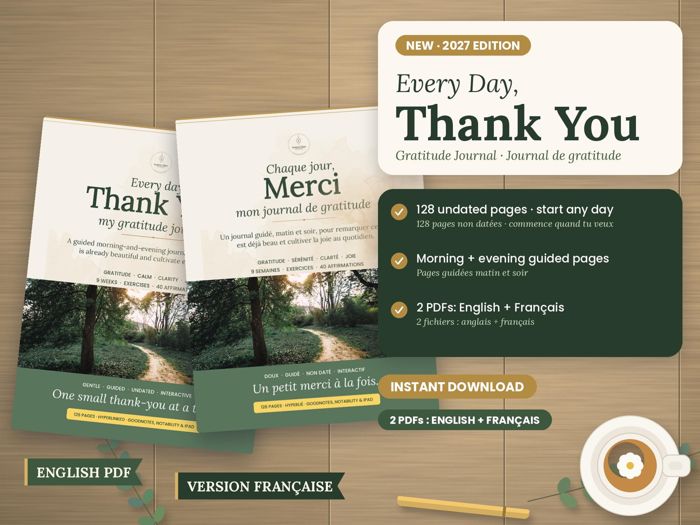
Some people like to do both: an intention in the morning and three thank-yous at night. That's the format of our Every Day, Thank You journal.
What to write: the rule of three specific things
The most common mistake is writing the same general list every day: "my family, my health, my home." It's true, but with repetition it loses its effect. Try to be specific instead:
- instead of "my daughter," write "my daughter's giggles at dinner when the cat jumped on the table";
- instead of "my job," write "my coworker who brought me a coffee without me asking";
- instead of "nature," write "the orange light on the snow on my way back from the grocery store."
Then add one sentence about why it felt good. That moment of reflection is what makes the practice powerful.
20 prompts so you never run out of ideas
- What small moment made me smile today?
- Who helped me recently, even a little?
- What smell, sound or taste did I enjoy today?
- What turned out easier than expected?
- Which part of my body can I thank today?
- Which object in my home makes my life easier?
- Who would I miss the most if they weren't here?
- What did I learn this week?
- Which memory warms my heart?
- Which place makes me feel good?
- Which challenge helped me grow?
- Which song, book or movie touched me?
- What do I take for granted that is actually precious?
- What quality do I appreciate in myself?
- What kindness did I receive from a stranger?
- What am I proud of today?
- Which meal did I especially enjoy?
- What simple thing makes me happy this month?
- What's beautiful about the current season?
- What am I thankful for, even while going through something hard?
How to make it a habit that lasts
- Keep your journal in sight: on your nightstand or next to your coffee maker.
- Attach it to an existing habit: after brushing your teeth, during your first coffee.
- Start with one line on tired days. One line is better than none.
- Add a small weekly challenge: write a gratitude letter, notice your five senses, thank someone out loud.
- Reread your entries now and then. Reading your thank-yous on gray days often helps.
Gratitude when everything feels wrong
Gratitude doesn't require denying pain. During grief, illness or a hard season, you can write both what hurts and what still helps a little: a message you received, a warm drink, an hour of sleep. This is sometimes called "gratitude despite the pain." If it feels too hard, set the journal aside for a few days, without guilt.
A sample entry
Not sure what a good entry looks like? Here's an example of a five-minute evening page:
- "The barista remembered my order and smiled. It made me feel seen on a busy morning."
- "My sister called just to chat. I laughed for the first time in days."
- "The soup I made with leftovers turned out delicious. I'm proud I took care of myself."
Tomorrow's intention: "Take a real lunch break, away from my screen."
That's it. Specific, short and honest. Over time, these small pages become a collection of proof that good moments exist, even in ordinary or difficult weeks.
Frequently asked questions
How long should I write each day?
Five minutes is enough. Consistency matters more than length. Three specific sentences are better than a long page written once a month.
What if I have nothing to write?
Start with tiny things: a warm drink, comfortable clothes, a song. You can also use one of the 20 prompts in this article or a guided journal.
Is a paper or digital journal better?
Both work. Paper helps you disconnect from screens; digital (in GoodNotes or another app) is handy if your tablet is always with you. Our journals work both ways, since you can print them.
Can you keep a gratitude journal as a family?
Yes. A "dinner thank-you," where everyone shares one good moment from their day, is a lovely way to introduce children to gratitude.
Sources
- Greater Good in Action (UC Berkeley): Gratitude Journal
- Greater Good Science Center: How keeping a gratitude journal can heal your heart
This article is written with the help of artificial intelligence and reviewed by the Lantern Days team. It does not replace advice from a professional. See our Artificial intelligence page.

Subscribe and get 2 gifts


