
How to Write a Gratitude Letter (With a Simple Template)
A gratitude letter thanks someone in detail for what they did for you. How to choose the person, what to say, a simple template, and how to deliver it.
Published on November 11, 2026 · 5 min read

To write a gratitude letter, choose someone who made a difference in your life and whom you never properly thanked, then describe exactly what they did, why it mattered, and how it changed things for you. Writing it takes about ten minutes. Then, if you can, read it to them in person. That's where the real power is, for them and for you.
Here's how to choose the person, what to write, a simple template, and a few ideas for delivering your letter.
Why write a gratitude letter?
The gratitude letter is one of the most studied positive psychology exercises. Psychologist Martin Seligman of the University of Pennsylvania compared five exercises with hundreds of participants. Writing a gratitude letter and delivering it in person produced the biggest boost in reported happiness one month later, according to the Greater Good Science Center at UC Berkeley.
The effect faded after a few months. That's why researchers suggest repeating the exercise from time to time, for example roughly every six weeks.
Beyond the research, a gratitude letter does two simple things:
- it reminds you that people have taken care of you;
- it tells someone, in black and white, that they mattered. Many people never hear that.
Who should you write to?
Take a few minutes to scroll back through your life. The Greater Good Science Center suggests choosing someone who:
- did something important for you;
- you never really thanked;
- is still living, and whom you could see in the coming days.
A memory you haven't thought about in a long time often carries more weight than a recent event. A few ideas:
- a teacher who believed in you;
- a grandmother, aunt or parent;
- a friend who showed up during a dark season;
- a coworker or boss who gave you a chance;
- a neighbor, a daycare teacher, a nurse;
- your partner, for one specific thing you tend to take for granted.
What if the person has died? The letter still has meaning, but it becomes an act of grief rather than an exchange. Write it anyway, for yourself: it can help you say what was left unsaid.
What to write: the 4 parts of a good letter
Don't worry about grammar or style. What moves people is detail. A strong letter usually includes:
- What the person did. A specific act, a period of time, something they said.
- Why it mattered. What you were going through then, and what their gesture gave you.
- How it changed you. Where you are today, partly thanks to them.
- How you still think of it. The fact that you remember what they did, sometimes often.
Speak directly to the person ("You were the one who…"), as if you were talking to them. One page is plenty, about 300 words.
A simple gratitude letter template
Use this structure and fill it with your own words:
Dear [name],
[Time ago], you [what they did]. I never really told you, but it meant so much to me.
Back then, I was [what you were going through]. Your [gesture, words, presence] gave me [what it brought you].
Today, I [what you're doing now], and I know part of that path is thanks to you. I often think about [specific detail].
Thank you, from the bottom of my heart.
[Your name]
Treat this template as a support, not a script. If your words want to go somewhere else, let them.
The right card and the right pen
A handwritten gratitude letter is special: the person can keep it, reread it, tuck it into a memory box. But finding a nice card when the impulse strikes isn't always easy. Keeping a few cards and a good pen at home removes one more obstacle.
How to deliver your letter
According to the Greater Good Science Center, delivering it in person and reading it aloud seems to bring much greater benefits than writing alone. Here's how:
- arrange a visit without revealing everything ("I'd love to see you, I have something for you");
- tell the person you'd like to read them something and ask them to let you finish;
- read slowly, and notice their reaction and your own;
- take time afterward to talk about it together;
- leave the letter with them.
Plan for at least 30 minutes. If distance keeps you apart, a video call works too. And if reading it aloud feels impossible, mail it: that's already a beautiful gift.
What if I feel awkward or shy?
That's normal. Thanking someone deeply makes us vulnerable. A few ideas:
- start with someone you feel safe with;
- write the letter without deciding right away whether to deliver it;
- if you feel guilt or a sense of owing something (it happens, especially in some cultures, Berkeley researchers note), remember the goal isn't to repay a debt but to acknowledge a gift.
Make gratitude a habit
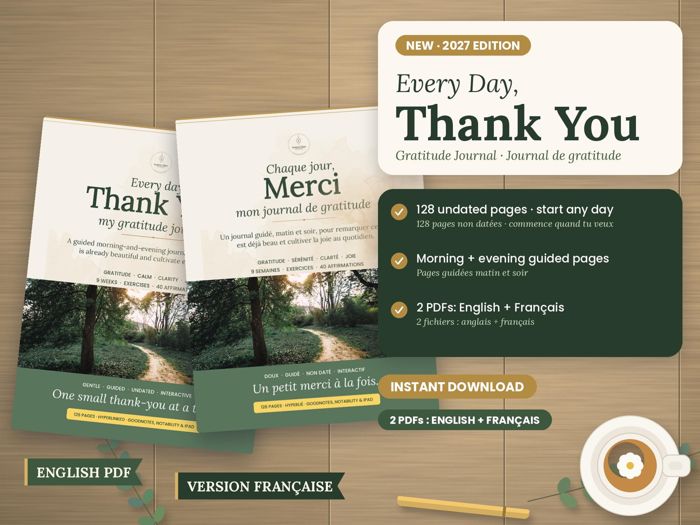
A letter is a powerful moment. To keep it from being a one-off, daily gratitude in a journal bridges the gap between letters. Our Every Day, Thank You journal gives you a prompt each day and room for your thank-yous, and helps you spot the people you might write your next letter to.
Frequently asked questions
How long does it take to write a gratitude letter?
About 10 minutes, according to the Greater Good Science Center. In studies, participants wrote for anywhere from 5 to 30 minutes. Take whatever time you need.
Does a gratitude letter have to be handwritten?
No, but a handwritten letter is easier to keep and reread. A sincere email or voice message has value too.
What if the person is no longer alive?
Write it anyway. It becomes a grief letter: a space to say thank you and what couldn't be said. You can keep it, read it at their grave, or share it with someone close.
How often should I write a gratitude letter?
Researchers found the effect fades after a few months. Writing one roughly every six weeks is a good way to keep gratitude alive.
Sources
- Greater Good in Action (UC Berkeley): Gratitude Letter
- Greater Good Science Center: Four Great Gratitude Strategies
- Harvard Health Publishing: Giving thanks can make you happier
This article is written with the help of artificial intelligence and reviewed by the Lantern Days team. It does not replace advice from a professional. See our Artificial intelligence page.

Subscribe and get 2 gifts


