
How to Make a 90-Day Plan to Reach Your Goals (Simple 12-Week Method)
How to create a 90-day plan for your goals: choose one goal, define success, break it into 12 weeks of small actions, plan obstacles and review every week.
Published on November 11, 2026 · 5 min read

A 90-day plan takes one meaningful goal and breaks it into three months of small steps, with a weekly check-in to move forward and adjust. To make one, choose a single goal that truly matters to you, describe what success looks like on day 90, split it into three monthly milestones and then weekly actions, and spend 15 minutes every Sunday reviewing your progress. Why 90 days? It's long enough to see real change and short enough to keep your momentum.
Why a 90-day plan works
A yearly goal feels far away. In March you think you have plenty of time, and by November you realize you've barely moved. A 90-day horizon changes that:
- The finish line is visible. You already know the date of your review.
- The steps are concrete. Twelve weeks is short enough to know exactly what to do this week.
- You can adjust quickly. If something isn't working, you notice within a few weeks, not at the end of the year.
This isn't just a feeling. In their review of 35 years of goal-setting research, published in American Psychologist, Edwin Locke and Gary Latham explain that specific, challenging goals lead to better performance than vague ones, that feedback on your progress is essential, and that adding short-term subgoals to a distant goal helps people stay confident and correct course. That's the whole logic of a 90-day plan.
Step 1: Choose ONE goal
A 90-day plan works best with one big goal, two at most. Ask yourself:
- What would change my life the most if it were done three months from now?
- What have I been putting off for a long time?
- Do I truly want this, or do I just think I "should"?
Goals that fit well: finishing a course, launching a small online shop, decluttering the house room by room, running a 5K, paying off a credit card, drafting the first chapters of a book.
Step 2: Describe success on day 90
Write one specific sentence as if it were already done: "By March 31, I've completed all 8 modules of my course and passed the final exam." Add why it matters to you. This sentence becomes your compass.
Make sure it's:
- specific (anyone could tell exactly what's done);
- measurable (you can answer yes or no on day 90);
- challenging but realistic for the time you actually have.
Step 3: Split it into three 30-day milestones
Divide your goal into three big pieces, one per month. For example, to launch a small online shop:
- Month 1: Prepare. Choose your products and name, take your photos.
- Month 2: Build. Set up the shop, write descriptions, set prices.
- Month 3: Launch. Open the shop, tell people about it, note what works.
Step 4: Turn each month into weekly actions
This is where the plan becomes real. For each month, list three to five actions per week. A good action:
- starts with a verb ("write," "call," "photograph");
- fits in one session (30 minutes to 2 hours);
- has a spot in your calendar (day and time).
Research on implementation intentions, summarized by the National Cancer Institute, shows that deciding in advance when, where and how you'll act helps you get started and stay on track. You can even add an if-then plan: "If I can't work on it Tuesday night, then I'll do it Saturday at 9 a.m."
Step 5: Plan for obstacles
Take five minutes to list what could get in your way: lack of time, fatigue, discouragement, a busy season at work, school holidays. For each one, write a simple fix. The National Institutes of Health (NIH) recommend exactly this: plan for obstacles and write down specific steps instead of relying on motivation alone.
Step 6: Review every week
The weekly check-in is the heart of the plan. Every Sunday (or whatever day suits you), take 15 minutes:
- What did I do this week? (Check it off. Seeing it matters.)
- What got in the way, and why?
- What are my three to five actions for next week?
- Where do they go in my calendar?
This regular feedback lets you adjust before you lose the thread.
Step 7: Celebrate and review on day 90
When the 90 days are up, give yourself an hour. Reread your starting sentence. What did you accomplish? What did you learn about the way you work? Even if you didn't reach the very end, look at how far you've come; it's usually further than you think. Then choose your next 90-day goal, or continue the same one with an adjusted plan.
A complete example
Goal: "By March 31, my home is decluttered and I can easily find what I need."
- Month 1: kitchen and entryway (two 45-minute sessions a week).
- Month 2: bedrooms and closets.
- Month 3: basement, paperwork and a 10-minute evening reset to keep things tidy.
- Expected obstacle: busy weekends. Plan: if Saturday isn't possible, then I do 20 minutes on Tuesday and Thursday evenings.
- Review: every Sunday, 15 minutes, with a before-and-after photo to see the progress.
A 90-day plan template, ready to fill in
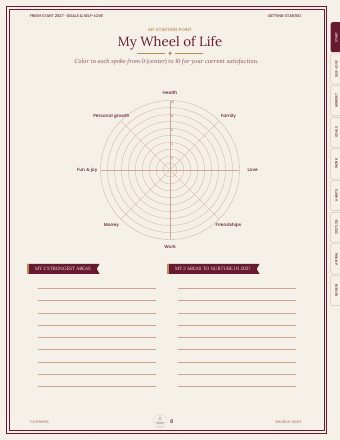
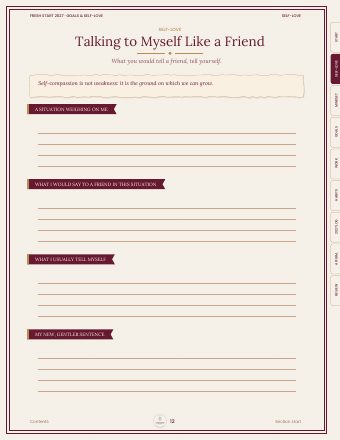
If you like having a structure for all of this, our Fresh Start 2027 journal includes a dedicated 90-day plan section, plus four quarterly plans, a page for your six key goals and month-by-month tracking with a monthly review. Everything connects: your 2026 review, your word of the year, your goals, and then your concrete steps.
Frequently asked questions
What is a 90-day plan?
It's a three-month action plan for one specific goal. You break it into three monthly milestones, then weekly actions, with a short weekly review to adjust as you go.
Why 90 days instead of a full year?
The end date is close enough to create a sense of urgency and far enough away to get a real result. Goal research also shows that short-term subgoals help people stay confident and adjust their strategy.
How many goals should a 90-day plan include?
One big goal is ideal, two at most. Keep your other ideas for your next 90-day plan.
What if I fall behind?
That's normal. During your weekly review, look at what got in the way, shrink your actions or move a milestone. What matters most is keeping your weekly check-in, even after a hard week.
Sources
- Locke & Latham, American Psychologist (2002): Building a Practically Useful Theory of Goal Setting and Task Motivation
- National Cancer Institute: Implementation Intentions
- NIH News in Health: Creating Healthy Habits
This article is written with the help of artificial intelligence and reviewed by the Lantern Days team. It does not replace advice from a professional. See our Artificial intelligence page.


Subscribe and get 2 gifts


