
End-of-Year Reflection: 30 Questions to Look Back on 2026
Reflect on your year with 30 end-of-year reflection questions, sorted by theme, plus a simple 4-step method to look back on 2026 and plan for 2027.
Published on November 11, 2026 · 6 min read

An end-of-year reflection is a chance to pause and look at the year that's ending before rushing into the next one. The simplest way to do it: set aside a quiet hour, answer a few questions in writing about what you lived, learned and felt, then carry two or three lessons into 2027. You don't need to analyze everything. Here are 30 end-of-year reflection questions, sorted by theme, and a gentle method to look back on 2026.
Why it's worth reflecting on your year
Most of us slide from one year into the next without stopping. But looking back helps you move forward. A study by researchers from Harvard Business School and other universities shows this well: at a call center, new employees in training spent the last 15 minutes of each day writing about what they had learned. By the end of training, they scored 22.8% higher on their final test than a group that simply worked 15 extra minutes a day. The researchers linked the effect partly to a stronger sense of competence: reflecting helps you notice your own progress.
A year-in-review is the same idea on a bigger scale. It helps you:
- see how far you've come, even when it feels like you haven't moved;
- recognize what made you feel good, so you can do more of it;
- spot what drained you, so you can do less of it;
- choose your 2027 goals based on your real life, not an ideal list.
How to do your year-end reflection in 4 steps
- Pick your moment. An hour on a quiet evening or a Sunday morning. Some people like to spread it over two or three sessions in December.
- Scroll back through your year. Look at your calendar, photos and important messages. Jot down the big moments month by month, without judging them.
- Answer the questions in writing. You don't need to answer all 30: choose the ones that speak to you. Writing helps you go deeper than thinking alone.
- End with your lessons. Sum up, in two or three sentences, what you want to carry from 2026 into the new year.
30 end-of-year reflection questions
What you lived
- What are three moments from 2026 you want to remember?
- What are you proudest of this year, even if no one else saw it?
- What did you do for the first time?
- What was the hardest moment, and how did you get through it?
- What decision changed something for you?
- If your year were a movie, what would the title be?
What you learned
- What did you learn about yourself?
- What mistake taught you something useful?
- Which habit was good for you?
- Which habit do you want to leave behind?
- What advice would you give the person you were in January?
- What took up more space in your life than you expected?
Your relationships
- Who supported you the most this year?
- Who would you like to thank?
- Which relationship grew stronger?
- Which relationship took too much of your energy?
- Were you able to say no when you needed to?
- Who do you want to spend more time with in 2027?
Your well-being
- When did you feel most at peace?
- What gave you energy?
- What took it away?
- How did you take care of yourself?
- What made you laugh?
- What did you need more of: rest, time alone, projects, people?
Your goals and your future
- Which 2026 goals did you reach, even partly?
- Which ones did you set aside, and why?
- What matters most to you right now?
- What do you want to feel more often in 2027?
- What small change would make a big difference?
- If you had one word for 2027, what would it be?
What to do with your answers
Once you're done, read everything back and underline what keeps coming up. Often one theme stands out: a need for rest, a pull toward a new project, a relationship that needs care. That theme can guide your 2027.
Then keep a single page with:
- your three proudest moments of 2026;
- your two or three lessons;
- one to three intentions for 2027.
The American Psychological Association recommends not trying to change too much at once: one change at a time, broken into small, concrete steps, is more likely to last. That's why a year-end review is mostly about choosing, not overhauling everything.
Reflect without judging yourself
A year in review isn't a report card. Some years, the biggest achievement is that you kept going. If 2026 brought a loss, a breakup, an illness or deep exhaustion, your reflection can simply honor everything you carried. It's okay to write, "I made it through this year, and that's a lot."
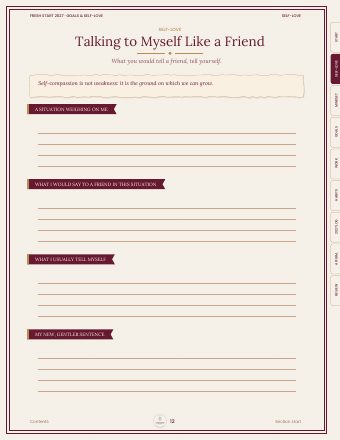
For any hard question, add this small prompt: "What would I say to a friend who gave me this same answer?" It helps you look at your year more kindly.
From reflection to your 2027 plan
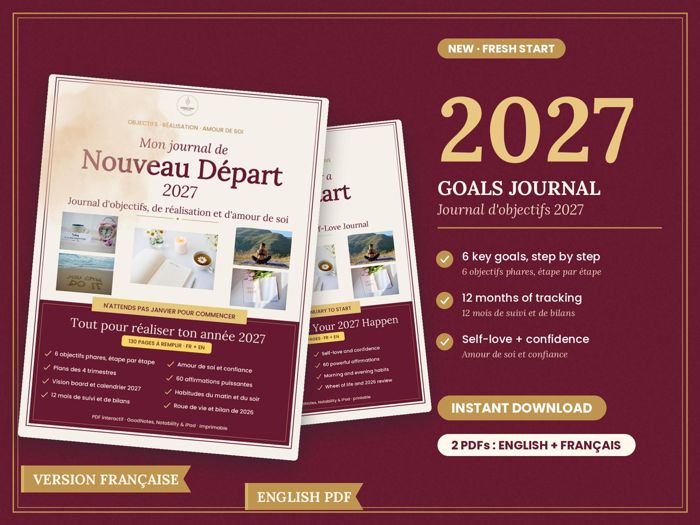
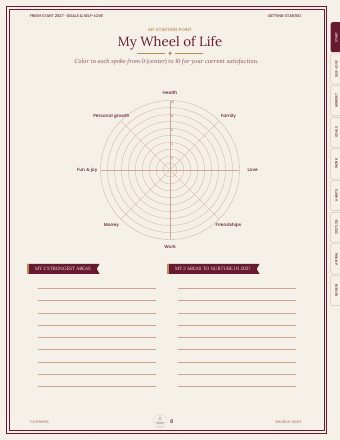
Reflection is the first step. The next is turning your lessons into realistic goals. Our Fresh Start 2027 journal opens with a guided 2026 review, the wheel of life, your values and your word of the year, then helps you choose your goals and break them into quarterly and monthly plans.
A few ideas to make the shift:
- Choose one word that captures the spirit you want for your new year.
- Write one intention for each important area of your life (health, family, work, you).
- For each intention, note a very first step you can take in January.
- Plan a mini-review at the end of each month to adjust as you go.
Reflecting as a couple or a family
You can also do your year in review with your partner, a friend or your kids. Pick four or five simple questions (best moment, what we learned, what we want to do together next year) and take turns answering over a meal. Kids especially love the movie-title question. Keeping the answers from year to year becomes a lovely keepsake.
Frequently asked questions
When should I do my end-of-year reflection?
There's no single right time. Many people do it between Christmas and New Year's, when life slows down. Others like to start in late November so they reach January with a clear plan.
How long does a year-end review take?
An hour is enough for a meaningful review. You can also split it into several 15-minute sessions. What matters most is writing your answers down, not answering every question.
How do I reflect on a really hard year?
Start by acknowledging what you went through, without looking for a lesson right away. Choose the questions about support, what helped you and what you need now. If the pain feels heavy, talk to someone you trust or a professional as well.
What's the difference between a year in review and resolutions?
A year in review looks back to understand your year. Resolutions look ahead. Reflecting first helps you pick goals that fit you better and feel more realistic.
Sources
- Harvard Business School Working Knowledge: Reflecting on Work Improves Job Performance
- American Psychological Association: Making lifestyle changes that last
This article is written with the help of artificial intelligence and reviewed by the Lantern Days team. It does not replace advice from a professional. See our Artificial intelligence page.

Subscribe and get 2 gifts


