
How to Build a New Habit That Actually Sticks (It's Not 21 Days)
How long does it take to form a habit, and how do you make it stick? Start tiny, stack it on an existing routine, shape your space, track it and bounce back.
Published on November 11, 2026 · 5 min read

A habit is something you do almost without thinking, because you've repeated it often enough in the same situation. To build one, start with a tiny version, attach it to something you already do every day, make it easy in your environment, track each time you do it and, if you miss a day, simply pick it back up the next day. And no, it doesn't necessarily take 21 days. Here's what the research actually says, and how to put it into practice.
How long does it take to form a habit?
The famous "21 days" doesn't come from a scientific study of habits. Research from University College London (UCL) followed people who each took on a new daily behavior of their choosing. On average, it took about 66 days for the behavior to feel automatic, but the time varied a great deal from person to person.
Two pieces of good news came out of that research:
- Missing a day doesn't ruin everything. Skipping one opportunity now and then didn't meaningfully affect habit formation.
- Consistency still matters. People who were very inconsistent didn't form a habit.
In other words: aim for consistency, not perfection, and give yourself at least two months before it feels natural.
Why changing is so hard
The National Institutes of Health (NIH) explain that repeated behaviors that feel rewarding can turn into habits that are hard to change, often triggered automatically by a situation: evening TV that calls for a snack, a break that calls for your phone. That's why willpower alone often isn't enough. It works better to use those triggers instead of fighting them.
How to build a new habit in 7 steps
1. Pick just one habit
One at a time. Choose the habit that would have the biggest impact on your life, or the one you care about most. The others can come later.
2. Start ridiculously small
Your starting version should be so easy you can't say no, even on an exhausted evening:
- instead of "read for 30 minutes," read one page;
- instead of "meditate for 20 minutes," take three slow breaths;
- instead of "work out," put on your sneakers and walk to the corner.
The NIH recommend setting small, realistic goals. Once the habit is solid, you can make it longer.
3. Stack it onto something you already do
Choose a specific moment that happens every day and place your new habit right after it. The formula: "After [current habit], I will [new habit]."
- "After I brush my teeth at night, I'll write three things I'm grateful for."
- "After I drop the kids off at school, I'll walk for 10 minutes."
- "After I pour my coffee, I'll read one page."
This is a form of implementation intention: deciding in advance when and where you'll act. According to the National Cancer Institute, which summarizes this research, a meta-analysis of 94 studies found that these plans had a meaningful effect on following through.
4. Shape your environment
Make the good habit easy and visible, and the old one harder. The NIH suggest making the healthy choice the easy choice:
- book on your pillow, phone in another room;
- a full water bottle on your desk;
- yoga mat already rolled out in the living room;
- notebook and pen next to the coffee maker.
5. Make it enjoyable
We repeat what feels good. Pair your new habit with something you love: your favorite music on your walk, a beautiful notebook for writing, a cup of tea with your evening reading.
6. Track it every time
The NIH describe self-monitoring as one of the best predictors of success. A check mark on a calendar or a monthly habit tracker is enough. Watching the row of checks grow makes you want to keep it going, and shows you in black and white that you're making progress.
7. Have a plan B
There will be off days. Decide your minimum version in advance: "If I'm short on time, I'll do at least one minute." And your restart rule: "If I miss a day, I start again tomorrow." The American Psychological Association reminds us that lapses are part of change and don't mean all is lost.
What about breaking a bad habit?
It's often easier to replace a habit than to erase it. First notice what triggers the old habit: a time, a place, a feeling. Then choose a new action for that same trigger. For example, if you grab your phone the moment you sit on the couch at night, leave it charging in the kitchen and put a book or your knitting on the couch instead. A large Swedish study on New Year's resolutions also found that goals framed as "start something" were more successful than goals framed as "stop something."
Easy habits to start with
- Write three things you're grateful for before bed.
- Drink a glass of water when you wake up.
- Walk for 10 minutes after lunch.
- Tidy the kitchen for 5 minutes before bed.
- Read one page every night.
- Lay out tomorrow's clothes the night before.
- Plan your week on Sunday in 20 minutes.
A habit tracker for the whole year
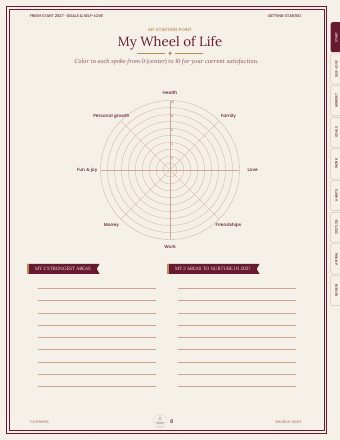
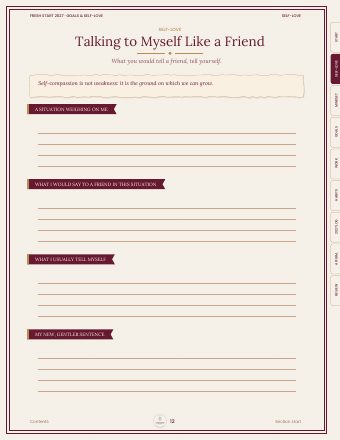
To keep your check marks in the same place as your goals, our Fresh Start 2027 journal has a Habits section with monthly trackers and morning and evening ritual pages, along with your goals for the year, quarterly plans and monthly reviews. You can see at a glance what's moving forward and adjust each month.
Frequently asked questions
Does it really take 21 days to form a habit?
No, that number isn't based on solid research. A University College London study found an average of about 66 days, with big differences from one person to another.
What if I miss a day?
Just start again the next day. In the UCL study, missing an occasional opportunity didn't meaningfully affect habit formation. What matters is not letting one missed day turn into a missed week.
How many habits can I build at once?
Ideally, one. Once it happens almost on its own, add another. Trying to change everything at the same time is one of the most common reasons people give up.
How do I stay motivated?
Don't rely on motivation alone; it rises and falls. Instead, make the habit tiny, easy and enjoyable, stack it onto an existing routine and track your progress. And remind yourself why it matters to you.
Sources
- University College London: How long does it take to form a habit?
- NIH News in Health: Creating Healthy Habits
- National Cancer Institute: Implementation Intentions
- American Psychological Association: Making lifestyle changes that last
- Stockholm University: How to succeed in keeping your New Year's resolution
This article is written with the help of artificial intelligence and reviewed by the Lantern Days team. It does not replace advice from a professional. See our Artificial intelligence page.


Subscribe and get 2 gifts


