
Digital Detox: 10 Realistic Ways to Spend Less Time on Your Phone
Picking up your phone without thinking? 10 realistic ways to spend less time on your phone, what the research says, and a gentle 7-day digital detox plan.
Published on November 11, 2026 · 6 min read

You pick up your phone to check the time, and twenty minutes later you're still scrolling. You're not alone, and it isn't a lack of willpower: apps are designed to hold our attention. To spend less time on your phone, you don't need to throw it away. You need a little distance: keep it physically out of reach, turn off the notifications and apps that pull you in, set phone-free times, and replace scrolling with things you actually enjoy. Here are ten realistic ways to do it.
What the research says
Two North American studies help explain why a little distance goes a long way.
At the University of Alberta, a team led by Noah Castelo asked 467 adults to block mobile internet on their phones for two weeks (they could still call and text). The study, published in PNAS Nexus in 2025, reported that about 70% of participants said their mental health improved and 73% reported better well-being. They also spent more time socializing in person, exercising and being outdoors. The researchers note a limitation: participants knew the study was about phone use, which may have shaped their answers. Tellingly, many people couldn't keep the block in place for the full two weeks, a reminder of how hard this is.
At the University of Texas at Austin, Adrian Ward and colleagues gave attention tests to nearly 800 people. Those whose phones were in another room did significantly better than those with phones on the desk, even when the phone was turned off or face down. Simply resisting the urge to grab it seems to use up part of our attention.
The message: you don't have to quit entirely. Getting your phone out of sight is already a big step.
1. Check your screen time first, without judging yourself
Your phone already tracks your screen time (Settings → Screen Time on iPhone, Digital Wellbeing on Android). Look at it once, with curiosity rather than criticism. Which apps take the most time? At what times of day? That's your starting point.
2. Turn off almost all notifications
Every notification is a small invitation to pick up your phone. Keep only the ones from people (calls, messages from those close to you) and turn off social media, games, shopping and news alerts. You'll check when you decide to, not when an app decides for you.
3. Put physical distance between you and your phone
That's what the Texas study shows: distance matters. At work, keep your phone in your bag or a drawer. At home, give it a fixed "spot" away from the couch and the table. At night, let it sleep outside the bedroom. If your alarm is the reason it stays by your bed, a simple old-school alarm clock solves that.
And if the pull is just too strong, there are timed lock boxes: you put your phone inside, choose a time, and the box only opens when it's up. You don't have to rely on willpower at all.
4. Clean up your home screen
Move the apps that pull you in (social media, video, games) into a folder on your last screen. Better yet, delete one for a month and use it only on your computer. That tiny extra step is often enough to break the automatic habit.
5. Use your phone's built-in limits
Your phone's settings let you set a daily limit for each app, or turn on Focus or Do Not Disturb at certain hours. As experts quoted by AARP suggest, start small: a few hours or one evening, rather than a big two-week challenge you're likely to give up on.
6. Create phone-free zones and times
Pick two or three moments where your phone doesn't belong:
- Meals, especially family meals.
- The first half hour of your morning.
- The hour before bed.
- The bedroom.
Kids are usually thrilled to become the "phone police" for this rule. They'll be happy to remind you.
7. Tell good use apart from mindless scrolling
Not all screen time is the same. A video call with your sister, a message to a friend, a puzzle game: these are active uses, and often enjoyable. Endless scrolling tends to leave you feeling empty. Experts quoted by AARP recommend noticing when your phone helps you or brings you joy, and when it drains you. Keep the first kind, cut back on the second.
8. Replace it, don't just remove it
If you take your phone away without putting anything in its place, the urge comes right back. Keep easy alternatives within reach:
- A book on the coffee table.
- A puzzle already in progress.
- Walking shoes by the door.
- A notebook and pen in your bag.
- Knitting, coloring, an instrument.
In the Alberta study, participants spent more time with other people, outdoors and moving. Those activities, especially with people you love, are often what make unplugging feel good.
9. Notice what you gain
Each evening during your detox, write down one thing you did instead of being on your phone: a conversation, a chapter, a sunset. It's a way to see that you're not "missing out" but getting time back. Our Every Day, Thank You journal has a simple evening page for noting these small moments.
10. Build it as a habit, one step at a time
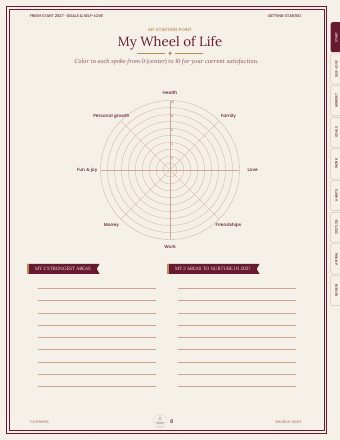
A digital detox works better as a series of small habits than as one big push. Week 1: notifications off. Week 2: phone out of the bedroom. Week 3: screen-free meals. Our Fresh Start 2027 journal helps you break a goal like this into small steps, with a tracker to see your progress.
A gentle 7-day digital detox
If you want to start today:
- Day 1: Check your screen time and write it down.
- Day 2: Turn off app notifications.
- Day 3: Move your most tempting apps to the last screen.
- Day 4: Your first phone-free dinner.
- Day 5: Phone out of the bedroom overnight.
- Day 6: One phone-free hour outside or with someone.
- Day 7: Check your screen time again and keep what worked.
When to talk to someone
If you feel you can't stop despite your efforts, or your phone is mostly a way to escape sadness, anxiety or loneliness, talk to your doctor or a mental health professional. That isn't a weakness; it's often a sign something else needs attention.
Frequently asked questions
How much screen time is too much for adults?
There's no magic number for adults. A good test is whether your screen time keeps you from sleeping, seeing people, moving or doing what matters to you. If it does, it's a good time to cut back.
Does a digital detox actually work?
A University of Alberta study published in 2025 found that blocking mobile internet for two weeks was linked to better well-being in most participants. The researchers note, though, that participants were motivated and knew what the study was about.
How do I stop picking up my phone without thinking?
Make it harder: phone out of sight, notifications off, tempting apps tucked into a folder. And keep a pleasant alternative within reach, like a book or a notebook.
Do I need to delete social media?
Not necessarily. Many people keep their accounts but only use them on a computer, or at set times. Try one month without the app on your phone and see what changes for you.
Sources
- AARP: Spending Too Much Time Scrolling? Cutting Back Benefits Well-Being
- University of Texas at Austin: The Mere Presence of Your Smartphone Reduces Brain Power, Study Shows
- NIMH: Caring for Your Mental Health
This article is written with the help of artificial intelligence and reviewed by the Lantern Days team. It does not replace advice from a professional. See our Artificial intelligence page.
To go further



Subscribe and get 2 gifts


