
50 Positive Affirmations for Self-Confidence (and How to Make Them Work)
50 positive affirmations for self-confidence, sorted by what you need, plus what research says about making affirmations feel true and actually help.
Published on November 11, 2026 · 7 min read

A positive affirmation is a short sentence, in the present tense and the first person, that reminds you of a quality, a value or a truth about yourself: "I'm doing my best with what I have today." Chosen well and repeated often, affirmations can soften your inner voice and help you rebuild confidence. Chosen badly, they can feel fake, and that's where many people give up.
Below you'll find what research actually says, how to write affirmations that feel true, and 50 examples grouped by what you need most.
Do positive affirmations actually work?
The honest answer: often, yes, but they aren't magic.
In October 2025, the American Psychological Association highlighted a meta-analysis published in American Psychologist. Researchers pooled 129 studies with nearly 17,750 participants. They found that brief self-affirmation exercises, in which people reflect on their core values, identity and positive traits, were linked to better general well-being, a more positive view of oneself, and less negative mood. On average, the effects were still there about two weeks later.
There's an important catch, though. A 2009 study from the University of Waterloo (Wood, Perunovic and Lee) found that repeating a statement far from what you believe, such as "I'm a lovable person" when you feel the opposite, could leave people with low self-esteem feeling worse. Your brain argues back: "That's not true."
What to take from this:
- an affirmation has to be believable to you, right now;
- affirmations about your values and your efforts tend to land better than big promises;
- repetition over days and weeks is what makes the difference.
How to write an affirmation that feels true
Cleveland Clinic psychologist Lauren Alexander, PhD, suggests a few simple principles.
- Start from a negative thought you have often. "I'll never manage this" can become "I'm learning one step at a time."
- Use the present tense, as if it's already true, without exaggerating.
- Make it personal. Name a quality you really have, a good decision you made, or your worth in general.
- Use your own words. A borrowed phrase that doesn't move you will stay just a phrase.
A helpful trick: if an affirmation feels too big, add "I'm learning to" or "more and more." "I trust myself" becomes "I'm learning to trust myself." It's gentler, and your mind accepts it more easily.
50 positive affirmations for self-confidence
Read slowly. Keep only the ones that give you a small inner "yes."
To believe in yourself
- I'm doing my best with what I have today.
- I'm learning to trust myself.
- I've been through hard things before, and I'm still here.
- My effort counts, even when no one sees it.
- I'm allowed to take up space.
- My worth isn't measured by my productivity.
- I can do hard things.
- I recognize my strengths without shrinking them.
- I deserve respect, starting with my own.
- I'm capable of learning what I don't know yet.
For days full of doubt
- This feeling is temporary.
- I don't need to be perfect to move forward.
- One bad day doesn't erase my whole journey.
- I speak to myself gently, even when I make mistakes.
- I can start over at any point in the day.
- Doubt is normal; it doesn't get to decide for me.
- I take one step, then another.
- I welcome my emotions without judging them.
- I am more than my mistakes.
- Today, enough is enough.
To be brave
- I'm willing to try, even when I'm scared.
- My voice deserves to be heard.
- I can say what I think, calmly and clearly.
- Every attempt teaches me something.
- I choose courage over perfection.
- I'm allowed to ask for what I need.
- I step out of my comfort zone at my own pace.
- Failing is part of learning.
- I celebrate small wins.
- I'm proud of myself for trying.
For your body and self-image
- My body carries me every day, and I'm grateful for it.
- I treat my body with respect.
- I don't have to look like anyone else.
- I deserve to feel at home in my own skin.
- I take care of myself because I matter.
For your relationships
- I can say no without explaining myself.
- I surround myself with people who are good for me.
- I give love, and I receive it too.
- Other people's opinions don't define me.
- I'm worthy of friendship just as I am.
For your goals
- I'm moving toward what matters to me.
- I can build the life I want, one day at a time.
- My dreams deserve my time and energy.
- I choose goals that fit who I am.
- I'm consistent, even in small steps.
For the evening
- I did enough today.
- I forgive myself for what didn't work out.
- I'm grateful for what today taught me.
- I deserve rest.
- Tomorrow is a fresh page.
How to use affirmations every day
An affirmation you read once in an article is quickly forgotten. Here's how to weave a few into your routine.
- Pick three, not fifty. A handful of phrases repeated often beats a long list you never return to.
- Write them by hand. Writing slows you down and makes you notice each word. Copy your affirmation of the day every morning.
- Pair them with something you already do: brushing your teeth, pouring your coffee, buckling your seatbelt. It's the same logic as building any new habit.
- Say them out loud, even quietly. Some people like the mirror; others prefer saying them on a walk.
- Add evidence. After your affirmation, jot down one small fact that supports it. "I can do hard things: yesterday I made the phone call I'd been avoiding." That makes it more believable to you.
- Review them monthly. Your needs change. An affirmation that helped in January can be swapped out in March.
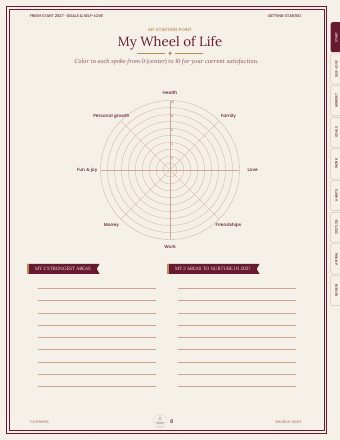
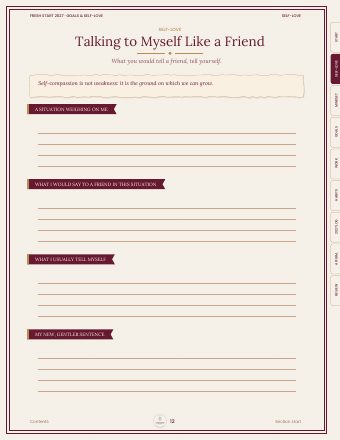
If you like having your affirmations close at hand, My Journal for a Fresh Start 2027 includes 60 affirmations and space to write your own, alongside pages on self-love, self-compassion and confidence. It's an easy place to return to each morning.
If you'd rather start with gentleness and gratitude, Every Day, Thank You offers 40 affirmations and morning and evening pages to notice what's going well. The two journals work beautifully together.
The 10-minute values exercise
Many self-affirmation studies don't use repeated phrases at all. They use a simple writing exercise about something you value.
- From a list (family, creativity, honesty, humor, friendship, nature, faith, learning…), choose the value that matters most to you right now.
- Write for 10 minutes: why it matters, a time you lived it, how it shows up in your life.
- Finish with one sentence: "I am someone who…" (for example, "I am someone who takes care of the people I love").
That last sentence becomes a sturdy affirmation, because it rests on your real story.
When affirmations aren't enough
Affirmations are one tool among many. They don't replace a trusted person's support or a professional's help. If self-doubt, sadness or very low self-esteem has been with you for a long time and weighs on your daily life, talking with your doctor, a psychologist or a counselor can truly help. Asking for help is also a way of trusting yourself.
Frequently asked questions
How many times a day should I repeat an affirmation?
There's no magic number. Consistency matters most: once or twice a day, at the same time, is a good starting point. Morning and bedtime are often the easiest moments.
Why do my affirmations feel fake?
Usually because the statement is too far from what you believe right now. Make it softer and more believable, for example with "I'm learning to" or "more and more," or anchor it to a real fact from your life.
Should I say "I am" or "you are"?
Both are used. Most people say "I." Some find it easier to speak to themselves in the second person, the way a friend would: "You're doing your best." Try both and keep whichever moves you more.
Can affirmations help kids?
They can be a lovely way to encourage a child, especially when they focus on effort ("I keep trying") rather than results. The 2025 meta-analysis found benefits in teens as well, somewhat smaller than in adults for self-image.
Sources
- American Psychological Association: Self-affirmations can boost well-being, study finds
- Cleveland Clinic: Do Positive Affirmations Work?
- PubMed: Positive self-statements: power for some, peril for others (Wood, Perunovic & Lee, 2009)
This article is written with the help of artificial intelligence and reviewed by the Lantern Days team. It does not replace advice from a professional. See our Artificial intelligence page.
To go further



Subscribe and get 2 gifts


