
How to Become the Best Version of Yourself: Where to Actually Start
Becoming the best version of yourself doesn't mean overhauling your life overnight. 6 gentle, research-backed steps, from your values to your strengths.
Published on November 11, 2026 · 5 min read

Becoming the best version of yourself doesn't mean becoming someone else. It means living more and more in line with what matters to you, your values, your strengths, and the life you want to build, one small step at a time. You don't start by changing everything. You start by knowing where you want to go, then you pick a first move.
Here are six gentle steps, grounded in positive psychology, to actually get started.
Step 1: Stop starting from what's wrong
Many self-improvement plans begin with a long list of flaws: I'm disorganized, I eat badly, I don't exercise, I'm too impatient with the kids. That list gets discouraging fast.
The best version of you isn't a "fixed" version. It's one that builds on what's already good in you. Before you look for what to change, take a moment to write down:
- three things you're proud of in your life right now;
- three qualities the people close to you see in you;
- three recent moments when you felt most like yourself.
This isn't vanity. It's your real starting point.
Step 2: Get clear on your values
Your values are what give your life meaning: family, honesty, creativity, learning, freedom, generosity, faith, humor… When you live far from your values, you often feel empty or torn, even when everything looks fine from the outside.
A simple exercise:
- Write a list of about twenty values that speak to you.
- Narrow it to ten, then five, then three.
- For each, finish the sentence: "Living this value, for me, looks like…"
Those three values become your compass. When you face a choice, you can ask: "Which option brings me closer to my values?"
Step 3: Imagine your best possible life
The Greater Good Science Center at UC Berkeley shares a well-studied exercise called the "best possible self."
How to do it:
- Set aside 15 minutes somewhere quiet.
- Imagine your life a few years from now, if everything had gone as well as it possibly could: your relationships, work, health, hobbies, what you've accomplished.
- Write continuously, in the present tense, as if it were already true. Set aside obstacles like money or time for now.
- Be specific: the more detail, the more engaged you'll be.
According to Greater Good, imagining your best possible self is linked to greater optimism and positive emotion, and that optimism can motivate you to work toward your goals. The center also notes it doesn't work for everyone: if the gap between your current life and your ideal one discourages you, focus on the small, realistic details.
Step 4: Know and use your strengths
Psychologists Christopher Peterson and Martin Seligman, two leading figures in positive psychology, described 24 character strengths, such as curiosity, kindness, perseverance, humor, gratitude and bravery. Their questionnaire, the VIA Survey, is presented by the University of Pennsylvania's Positive Psychology Center and can be taken online.
Whether or not you take the survey, ask yourself:
- When do I feel most energized?
- What do people come to me for?
- What do I do well without much effort?
Becoming better often means using your strengths more, and in new ways. A very curious person might sign up for a class; a very kind person might write a thank-you note every month.
Step 5: Choose ONE change at a time
Trying to change everything at once is the surest way to give up on everything. Based on your values and your "best possible life," pick one area for the next 90 days: health, relationships, organization, creativity, career…
Then turn it into a small, concrete action:
- "Be more present with my kids" becomes "15 minutes of phone-free play after dinner."
- "Take care of myself" becomes "a 20-minute walk three times a week."
- "Keep learning" becomes "read 10 pages before bed."
Tie that action to something you already do (after coffee, after dinner) and track it daily. A small, steady habit goes further than a grand plan you forget about.
Step 6: Be kind to yourself along the way
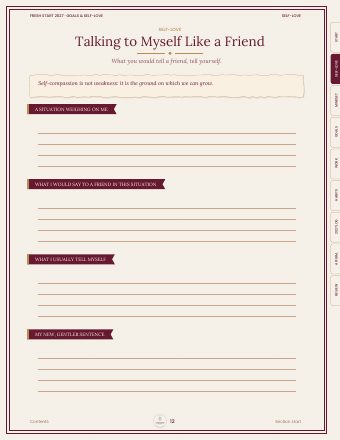
You'll miss days. That's normal, and it doesn't mean you've failed. UC Berkeley researchers Juliana Breines and Serena Chen found in 2012 that people who treated themselves with compassion after a mistake were more motivated to improve than those who criticized themselves.
In practice, when you slip:
- notice it without drama ("I skipped my walk yesterday");
- remember everyone goes through this;
- start again at the next possible moment, not "next Monday."
Becoming the best version of yourself also means becoming someone who speaks to herself more kindly.
Small things that make a big difference
Beyond big goals, a few simple habits tend to make life gentler, for you and for the people around you:
- Say thank you more often, and specifically.
- Keep your word, even in small things.
- Listen without planning your reply.
- Apologize when you get it wrong.
- Do a small kindness without expecting anything back.
- Spend time alone reflecting on your week.
One journal to hold it all
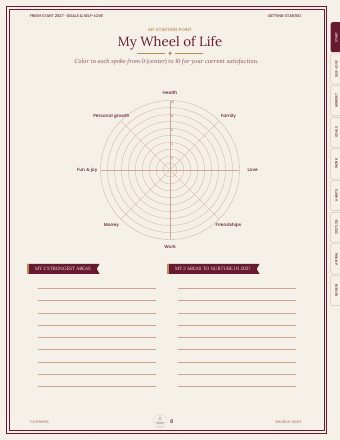
These steps go further when they're written down in one place. My Journal for a Fresh Start 2027 was designed for exactly this: a review of your year, the wheel of life, your values and your word for 2027; a section on self-love (self-compassion, boundaries, confidence); six key goals with quarterly plans, a 90-day plan and a vision board; habit trackers and morning and evening rituals; then 12 months of tracking so you can see how far you've come.
Frequently asked questions
Where do I start if I want to change my life?
Start with your values and with what's already going well, then choose one area and one small daily action. The rest gets easier once that first step is in place.
How long does it take to become the best version of yourself?
There's no finish line. It's a path, not a test. Give yourself checkpoints, such as a review every 90 days, so you can see your progress without waiting for perfection.
Is it selfish to focus on self-improvement?
No. When you live closer to your values and take care of yourself, you often have more patience, energy and presence for the people you love.
What if I feel stuck no matter what?
Sometimes what's holding you back is heavier than a lack of motivation: deep fatigue, lasting sadness, a season of grief. In those cases, slowing down and reaching out for support, to someone you trust or to a professional, is part of the path too.
Sources
- Greater Good Science Center (UC Berkeley): For the New Year, Try Imagining Your Best Possible Life
- Positive Psychology Center (University of Pennsylvania): VIA Survey of Character Strengths
- PubMed: Self-compassion increases self-improvement motivation (Breines & Chen, 2012)
This article is written with the help of artificial intelligence and reviewed by the Lantern Days team. It does not replace advice from a professional. See our Artificial intelligence page.


Subscribe and get 2 gifts


