
Why New Year's Resolutions Fail (and How to Actually Keep Them in 2027)
Why most New Year's resolutions fail, and how to keep yours in 2027: make it positive and specific, plan for obstacles, track progress, bounce back.
Published on November 11, 2026 · 5 min read

If you've ever dropped a resolution somewhere around the end of January, you're in good company, and it isn't a lack of willpower. Most resolutions fail because they're too vague, too big, framed as something to quit, or left without a plan for hard days. To keep yours, turn it into a specific, positive action, break it into small steps, track your progress and decide ahead of time what you'll do after a slip. Here's why resolutions stall, and what to do differently in 2027.
Why New Year's resolutions fail
They're too vague
"Take care of myself." "Get organized." "Exercise more." These are lovely intentions, but none of them tells you what to do on a Tuesday night. Decades of goal-setting research, summarized by Edwin Locke and Gary Latham in American Psychologist, show that specific goals lead to better results than a general "I'll do my best." A fuzzy goal leaves plenty of room for "I'll start tomorrow."
They're too big, too fast
January 1 arrives and we try to overhaul everything at once: food, sleep, money, workouts. The National Institutes of Health (NIH) suggest setting small, realistic goals instead, and thinking "baby steps rather than giant leaps." One change at a time has a far better chance of lasting.
They start with "stop"
"Quit sugar." "No more scrolling at night." A large Swedish study published in PLOS ONE in 2020 followed 1,066 people for a year after they made their resolutions. Approach goals (starting something new) worked better than avoidance goals (quitting or avoiding something). The researchers suggest replacing a behavior rather than simply banning it.
There's no plan for bad days
Exhaustion, a sick child, a packed week: some days, it just won't happen. Without a plan made in advance, one slip feels like proof that "it's ruined," and the whole resolution gets dropped.
It isn't really yours
The NIH point out that changes you want for yourself tend to last longer than changes made mostly to please someone else. If your resolution came from an ad or from comparing yourself on social media, it's likely to fizzle fast.
How to keep your resolutions: 7 steps
1. Pick one or two, not ten
List everything you'd like to change, then keep only what matters most to you this year. The rest can wait until spring.
2. Know your why
Write one sentence about what this change will give you. For example: "I want to walk more so I have more energy for my kids." When motivation dips in February, that sentence brings you back.
3. Make it positive
Turn each "don't" into a "do":
- "Stop snacking at night" becomes "make a cup of herbal tea and have a piece of fruit after dinner."
- "Less phone in bed" becomes "read ten pages before sleep."
- "Stop feeling overwhelmed" becomes "plan my week every Sunday."
4. Make it specific and measurable
What, when and how much? "Exercise" becomes "walk for 20 minutes on Monday, Wednesday and Saturday after lunch." You know exactly what to do, and you know when it's done.
5. Write an if-then plan
Researchers call this an implementation intention: "If this situation happens, then I will do this." According to the National Cancer Institute, which summarizes this research, a meta-analysis of 94 studies found these plans had a meaningful effect on reaching goals, both for getting started and for staying on track. Examples:
- "If it's raining, then I'll walk at the mall or do a yoga video."
- "If I get home too tired, then I'll do the short version: five minutes."
6. Track your progress
The NIH describe self-monitoring as one of the best predictors of success. A simple check mark on a calendar is enough. Watching a chain of small wins grow is more motivating than you might expect.
7. Decide now how you'll bounce back
The American Psychological Association reminds us that lapses are a normal part of change and no reason to give up. Write your rule: "If I miss a day, I start again the next day, without judging myself." One missed day doesn't erase the others.
Resolution makeovers
- Exercise more becomes: walk 20 minutes, three times a week, after lunch.
- Get organized becomes: plan my week for 20 minutes every Sunday evening.
- Make time for me becomes: a bath or a book on Thursday night, written in my planner.
- Save money becomes: move $25 into savings every payday.
- Be more grateful becomes: write three thank-yous every night before bed.
What if you planned the whole year instead?
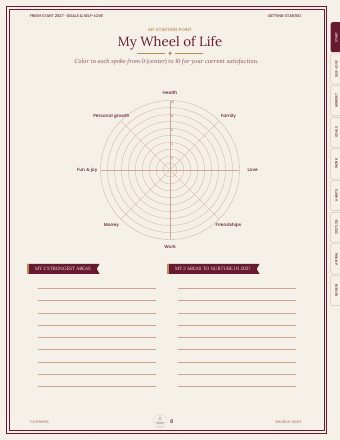
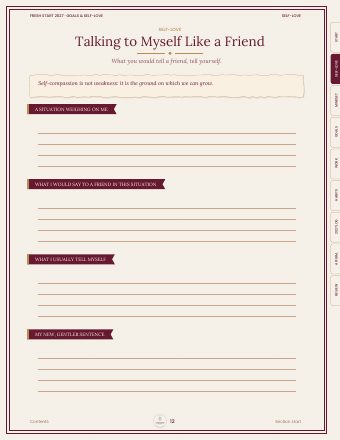
A resolution is often a single, isolated action. A real yearly plan connects what you want: a look back at the year that's ending, a few meaningful goals, quarterly steps and a short monthly check-in to adjust. That's exactly what our Fresh Start 2027 journal is built for: a 2026 review, your wheel of life, your word of the year, six key goals, quarterly plans, a 90-day plan and month-by-month tracking, along with self-love pages so you can move forward without being hard on yourself.
Do you have to wait for January 1?
No. New Year's is a wonderful moment for a fresh start, but you can begin on a Monday in November, on your birthday or after a vacation. Starting a little before January even has an advantage: you arrive on January 1 with a habit already underway instead of launching everything at once. And if your resolution no longer fits in March, you're allowed to adjust it. A goal is there to help you, not to punish you.
Frequently asked questions
Why do most people give up on their resolutions?
The most common reasons are goals that are too vague or too big, framed as things to quit, with no plan for obstacles. A single slip then feels like total failure, and people let the whole thing go.
How many resolutions should I make?
One or two is ideal. Every change takes attention and energy. It's better to succeed at one change that truly matters than to abandon five at the same time.
What's the best way to word a resolution?
Positively, with a specific action: what, when and how much. "Read ten pages every night" works better than "less phone time." A 2020 Swedish study found that "start" goals were more successful than "stop" goals.
What should I do if I've already given up?
Simply start again with a smaller version. Ask yourself what got in the way (time, a goal that was too big, fatigue) and write an if-then plan for that obstacle. It's never too late to pick it back up.
Sources
- PLOS ONE: A large-scale experiment on New Year's resolutions (Oscarsson et al., 2020)
- Stockholm University: How to succeed in keeping your New Year's resolution
- NIH News in Health: Making Your Resolutions Stick
- National Cancer Institute: Implementation Intentions
- American Psychological Association: Making lifestyle changes that last
This article is written with the help of artificial intelligence and reviewed by the Lantern Days team. It does not replace advice from a professional. See our Artificial intelligence page.


Subscribe and get 2 gifts


