
How to Let Go: 8 Practical Exercises to Stop Carrying Everything
How do you let go of things you can't control? 8 gentle, practical exercises: the circle of control, naming emotions, the unsent letter and more.
Published on November 11, 2026 · 5 min read

Letting go doesn't mean giving up or pretending everything is fine. Learning to let go means sorting what's in your control from what isn't, making room for the feelings that come with it, and putting your energy back where it can actually make a difference. It's a skill, not a personality trait, and you can practice it one small exercise at a time. Here are eight practical ways to start.
Why letting go feels so hard
Holding on is often a way of protecting ourselves. When we're afraid of losing something, being disappointed or getting hurt, we grip tighter: we replay the scene, plan for every scenario, try to hold it all together. In the moment, it feels like doing something. Over time, it wears you out, because so much of what we try to control simply isn't ours to control: other people's opinions, the past, certain decisions, the weather of life.
There's often a second layer, too: we judge ourselves for feeling sad, angry or worried. "I should be over this by now." That judgment piles extra weight on top of the first.
What research says about acceptance
Researchers at the University of California, Berkeley, and the University of Toronto ran three studies with more than 1,300 adults, reported by the Greater Good Science Center. People who habitually accepted their difficult emotions, without judging them, reported fewer negative emotions and better psychological health than people who fought their feelings or criticized themselves for having them. The researchers suggest that accepting an emotion gives it less attention, while constant judgment lets it build up.
Another study of 137 stressed adults compared a full mindfulness program with a version that left out the acceptance training. The program that included acceptance reduced stress significantly more. One of the authors makes an important point: acceptance isn't resignation, and it isn't tolerating mistreatment. It means accepting what's happening inside you so you can respond more wisely to what's happening around you.
Exercise 1: The circle of control
Take a sheet of paper and draw two circles, one inside the other.
- In the inner circle, write what's up to you: your words, your actions, your boundaries, how you care for yourself, the next small step.
- In the outer ring, write what isn't: what others think or do, what already happened, the final outcome.
Then look at the inner circle and pick one action for this week. Whenever your mind drifts to the outer ring, gently bring it back: "I can't decide that. What I can do is..."
Exercise 2: Name what you feel
When an emotion rises, name it calmly, the way you'd describe the weather: "There's sadness right now." "I notice anger." Don't try to push it away or analyze it. Simply naming it, without judgment, creates a little space between you and the feeling. It's one of the techniques suggested for practicing acceptance in daily life.
Exercise 3: Swap "I should" for "It makes sense"
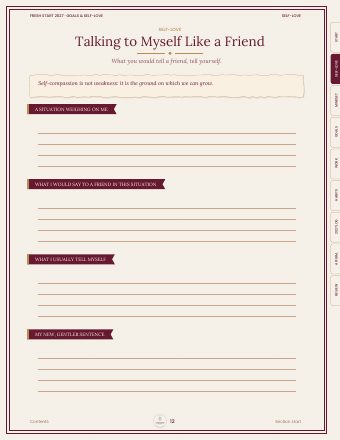
Listen to the sentences you tell yourself. "I should be stronger." "I shouldn't still be thinking about this." Try rephrasing them gently: "It makes sense that this still hurts. It mattered to me." Talk to yourself the way you'd talk to a friend going through the same thing. It isn't letting yourself off the hook. It's removing that second weight, the judgment.
Exercise 4: The letter you'll never send
Write a letter to the person, the situation, or even the version of yourself you need to release. Say everything: what hurt, what you wished for, what you regret, what you want to keep. You won't send it. The point isn't to get an answer but to get the words out of your head and set them down somewhere. Finish with a sentence that starts with "Today, I choose to..."
Some people like to seal the letter in an envelope afterward, tear it up, or keep it in a journal. Choose whatever gesture feels right to you.
Exercise 5: "What now?"
When you notice you're replaying a situation, ask yourself one question: "Is there anything I can do right now?"
- If yes: write down the action, pick a time to do it, and let the thought rest until then.
- If no: tell yourself, "For now, there's nothing to do. I can set this down." Then switch activities: a walk, some music, a simple task with your hands.
Exercise 6: Three thank-yous for what remains
Letting go can leave an empty space. So you don't see everything through the lens of what's missing, end your day by writing down three specific good things, even tiny ones. This doesn't deny the pain. It puts some light next to it. Our Every Day, Thank You journal guides you with one page a day that takes just a few minutes.
Exercise 7: The setting-down breath
Sitting comfortably, breathe in slowly through your nose and think "I notice." Breathe out even more slowly through your mouth and think "I set it down." Repeat five to ten times. With each exhale, picture yourself putting down a bag you've been carrying for a long time. You can pick it back up later if you need to, but for now, you set it down.
Exercise 8: Give your energy to what matters
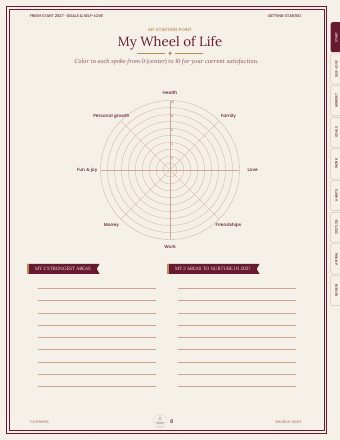
Whatever you take away from control needs somewhere to go, or your mind will drift back. Ask yourself: "If I weren't busy carrying this, what would I like to spend that time on?" A relationship, a project, your health, a dream you put aside. Pick one and write down one very small first step. Our Fresh Start 2027 journal includes pages on self-compassion and boundaries, plus goals broken down month by month.
Letting go of the past: a few guideposts
The past is the perfect example of something outside our control. A few guideposts can help:
- You can regret something without punishing yourself. Regret shows you what mattered.
- You can learn a lesson without replaying the scene a hundred times. Write the lesson down once, in one sentence.
- You can forgive, or not. Letting go doesn't mean excusing what hurt you.
- It takes time. It's normal for the thought to come back. Every time you gently bring yourself back, you're practicing.
When to reach out for help
If you can't stop thinking about a situation, if it's affecting your sleep, work or relationships, or if you've felt stuck for a long time, talk to your doctor or a therapist. Proven approaches, including ones that focus on acceptance, can really help. If you have thoughts of harming yourself, reach out for help right away.
Frequently asked questions
Does letting go mean giving up?
No. Giving up means you stop caring about what matters to you. Letting go means you stop fighting what you can't change, so you can save your energy for what you can. You can keep taking action while accepting that you don't control the outcome.
How long does it take to learn to let go?
There's no set timeline. It's a skill you build, like a muscle. At first, the thoughts will come back often. What changes over time is how quickly you're able to set them down again.
How do you let go of someone?
Start with the circle of control: what the other person thinks, feels or decides belongs in the outer ring. What's in the center is your boundaries, your actions and your needs. The unsent letter can also help you say what's still on your heart.
Why can't I accept what's happening to me?
Because it hurts, and resisting feels like protection. Accepting doesn't mean thinking it's okay. Try accepting your emotions first, without judging them: research suggests that's often what makes it possible to move forward.
Sources
- Greater Good Science Center: Feeling Bad About Feeling Bad Can Make You Feel Worse
- Greater Good Science Center: The Mindfulness Skill That Is Crucial for Stress
This article is written with the help of artificial intelligence and reviewed by the Lantern Days team. It does not replace advice from a professional. See our Artificial intelligence page.
To go further



Subscribe and get 2 gifts


