How to Make a Vision Board That Actually Works
How to make a vision board that helps you take action, not just dream: a 6-step method, the research-backed WOOP twist, and the supplies that make it easy.
Published on November 11, 2026 · 5 min read

A vision board is a collage of images and words that represent what you want for your future. To make one that actually works, pretty pictures aren't enough: add the obstacles that could hold you back and a simple plan to get past them. That's what research on the psychology of motivation suggests. Here's how to make a vision board that helps you take action, not just daydream.
Do vision boards actually work?
The honest answer: it depends on how you use them. Psychologist Gabriele Oettingen of New York University has spent years studying how our thoughts about the future shape what we do. Her research, widely covered in the media, points to something surprising: the more people fantasize about success in a purely positive way, the less likely they are to follow through. Your brain gets a little taste of the payoff, and the drive to act fades.
That doesn't mean you should stop dreaming. Oettingen developed an approach called mental contrasting: you picture the future you want, then take an honest look at what stands in the way. From it came a simple method called WOOP, which universities such as Oregon State share with students to help them reach their goals.
So a vision board that works combines two things: the inspiration of images and the realism of a plan.
The WOOP method in four words
- Wish: a goal that matters to you, challenging but doable, and chosen by you, not by someone else.
- Outcome: the best possible result. Picture it vividly: what it looks like and how it feels.
- Obstacle: your most likely inner obstacle. Not other people, not the weather: your own habit or inner voice that could pull you off track.
- Plan: an if-then plan. "If I'm too tired to write at night, then I'll write for 10 minutes the next morning."
That's the structure you'll add to your board.
How to make your vision board in 6 steps
1. Pick three to five wishes
Resist the urge to include everything. Three to five wishes from different areas of your life is plenty: one for you, one for your family or relationships, one for your work or a project, for example. An overloaded board turns into noise.
2. Gather your images and words
Flip through old magazines, print your own photos, cut out words, write phrases by hand. Choose images that make you feel something, not just "pretty" pictures. A photo of a cozy reading nook might capture "more time for me" better than a dream beach.
3. Set up your board and supplies
This is where a lot of vision boards stall: no board, scissors that tear the paper, nothing to hold the images up. A real cork board makes all the difference: you can move images around, add new ones through the year, and hang it where you'll see it every day.
4. Arrange your images by wish
Give each wish its own space. In the center, you could place your word of the year or one image that sums up the spirit of your year. Around it, group the images for each wish.
5. Add your obstacle and your plan
This is the step that makes the difference. Under each wish, pin a small card with:
- your most likely inner obstacle ("I procrastinate," "I doubt myself," "I say yes to everything");
- your if-then plan.
These little cards aren't as pretty as the pictures, but they're what turn your board into a tool.
6. Add a first step with a date
For each wish, write one tiny action to take in the next two weeks, with a date. "Call the community center about the pottery class before January 15." When it's done, check it off and write the next one.
Where to put your vision board
Hang it somewhere your eyes land often: near your desk, in your bedroom, or inside a closet door if you'd rather keep it private. You can also snap a photo of your board and use it as your phone wallpaper.
Most importantly, look at it with a question in mind. Not just "that's beautiful," but "what am I doing this week to get closer to that?"
A vision board inside your journal
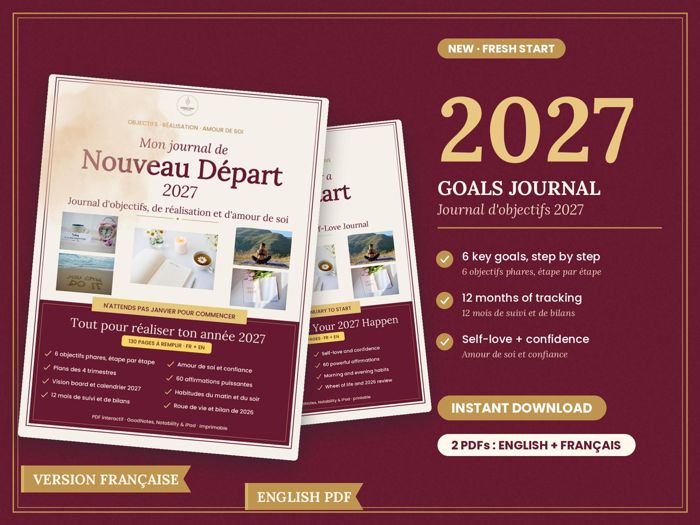
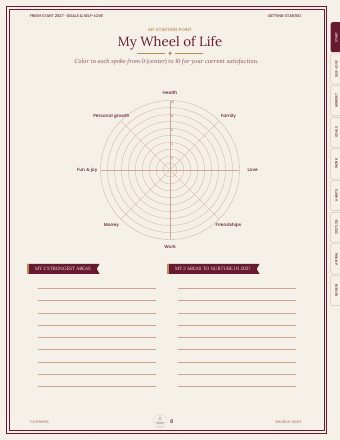
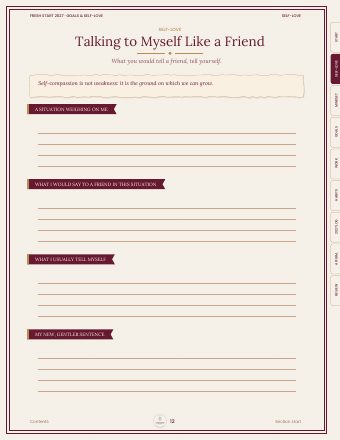
No room for a big board, or you'd rather keep your dreams to yourself? Our Fresh Start 2027 journal includes a vision board page, along with your six key goals, quarterly plans and a 90-day plan. Your board and your action plan live in the same place, on your tablet or printed out.
Common mistakes to avoid
- Pinning images that aren't really about you. If an image comes from someone else's dream (social media's, for instance), it won't motivate you for long.
- Making it all about money and things. Objects can have a place, but think about what you want to feel and experience, too.
- Making the board and forgetting it. Schedule a short monthly check-in to look at it, adjust your plans and celebrate progress.
- Judging yourself when a wish changes. Your board can evolve. Taking an image down is also a way of getting to know yourself better.
Making vision boards with friends or family
Vision boards are perfect for a night in with friends or an activity with kids. Everyone brings a few magazines, you share the scissors and glue, then each person presents their board. For kids, keep it simple: "three things I want to learn this year" and "one thing I want to do as a family." The time together becomes a lovely start-of-year memory.
Frequently asked questions
When should I make a vision board?
Many people make one in December or January, after reflecting on the past year. But you can make one anytime: on your birthday, at the start of summer or in September, whenever you feel ready for a fresh start.
What should I put on a vision board?
Images, words and phrases that represent three to five wishes that matter to you. To make it truly useful, add your most likely obstacle and an if-then plan for each wish.
Is a vision board the law of attraction?
Some people use it that way, but there's no evidence that an image can make something happen on its own. Motivation research suggests combining your dreams with an honest look at obstacles and a plan of action.
Should my vision board be paper or digital?
Both work. Paper is more hands-on and fun to make. Digital goes everywhere with you. What matters most is seeing it often and pairing it with small actions.
Sources
This article is written with the help of artificial intelligence and reviewed by the Lantern Days team. It does not replace advice from a professional. See our Artificial intelligence page.
Subscribe and get 2 gifts


