
How to Plan Your Week in 20 Minutes: A Simple Sunday Planning Routine
How to plan your week in 20 minutes: review last week, brain dump, block fixed commitments, choose 3 priorities and leave free time for yourself.
Published on November 11, 2026 · 5 min read

Planning your week means taking a few minutes to decide in advance where your time and energy will go, instead of chasing whatever feels urgent. In 20 minutes, on Sunday evening for example: review last week, do a quick brain dump, block your fixed commitments first, choose three priorities, give each one a specific time slot, then leave open space for surprises and for yourself. Here's the method, minute by minute.
Why weekly planning makes such a difference
Without a plan, the week decides for you: emails, other people's requests and small emergencies fill every gap. Time-management guides from several Canadian universities, including Memorial University of Newfoundland and Queen's University, recommend making a schedule at the start of each week: first block what's fixed, then add the tasks you need to do, include rest, and review it regularly.
Planning your week helps you:
- spot overloaded days at a glance and lighten them ahead of time;
- move forward on what truly matters, not just what's shouting the loudest;
- clear your head: once it's written down, you don't have to hold onto it.
The 20-minute method
Sit down with your planner, a pen and something nice to drink. Set a timer if it helps.
Minutes 1 to 3: Look back at last week
Three quick questions:
- What went well?
- What didn't get done and needs to move to this week?
- What do I want to do differently this week?
Minutes 4 to 7: Brain dump
Write down everything on your mind without sorting it: appointments, tasks, calls, errands, ideas, worries. Just getting it all onto paper often brings a lot of relief.
Minutes 8 to 11: Block what's fixed
Start by writing every commitment with a set time into your planner: work, appointments, kids' activities, meetings, plans with friends. That's the first step Memorial University recommends: block time-specific commitments before anything else. You'll immediately see how much time you really have left.
Minutes 12 to 15: Choose three priorities
From your list, choose the three most important things for this week, the ones that would make the week a success even if everything else waits. To help, Queen's University suggests the A-B-C method: A = due in a day or two, B = due within the week, C = later. Also include at least one important but non-urgent task (your goal, your health, a personal project). That's usually the one that gets pushed back forever.
Minutes 16 to 18: Give each priority a time slot
A priority without a specific time is just a good intention. Block time in your planner for each one: "Tuesday, 7 to 8 p.m.: prepare the presentation." Research on implementation intentions, summarized by the National Cancer Institute, shows that deciding when and where you'll act helps you follow through. Break big tasks into smaller pieces; they're easier to schedule and to estimate.
Minutes 19 and 20: Leave white space
Keep at least one open "just in case" block for surprises, and schedule real time for yourself: a walk, a book, a bath, coffee with a friend. University guides are clear on this: a realistic schedule includes breaks, sleep and flexibility. A week planned to 100% is a week that will overflow.
Tools that make planning enjoyable
The best tool is the one you actually want to open. Many women love planning on paper: you see the whole week at once, write by hand and add color. If your current planner doesn't have enough room for the week, or you can never find your notes, these two simple tools make a real difference.
A simple color code
If you use highlighters, keep the code very simple, three or four colors at most:
- one color for work;
- one for family and home;
- one for this week's priorities;
- one for time just for you.
When you look at your week, you'll see right away if one color is taking over, and whether the "time for you" color has disappeared.
Every evening: 2 minutes
Weekly planning pairs well with a tiny nightly habit, as Queen's University suggests: look at tomorrow. Check off what's done, move what isn't, and confirm tomorrow's priority. Two minutes is enough, and you go to bed with a calmer mind.
When your week falls apart
Sometimes it will: a sick child, a crisis at work, deep fatigue. That isn't a planning failure; it's life. Take two minutes to revisit your plan: what truly has to happen this week? What can wait? Keep just one priority if that's all you can manage. Next Sunday, you get a fresh start.
Connect your week to your goals for the year
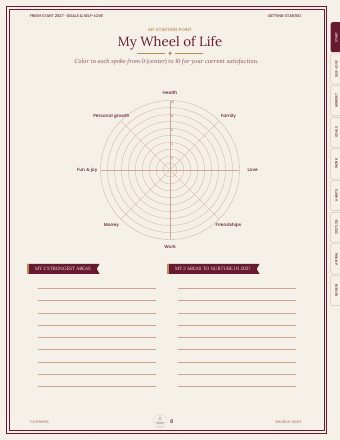
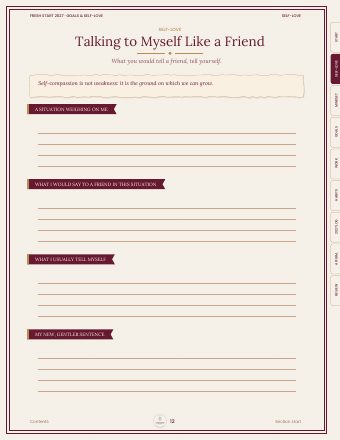
Weekly planning is even more powerful when each week moves a meaningful goal forward. Our Fresh Start 2027 journal ties it all together: your goals for the year, quarterly plans, a 90-day plan and 12 months of tracking with a calendar and monthly review. Your Sunday planning becomes the small weekly step toward your bigger goals.
Frequently asked questions
When is the best time to plan your week?
Many people like Sunday evening, so they start Monday with a clear head. Friday afternoon also works well, especially for the workweek. What matters most is keeping the same time every week.
How many priorities should I choose each week?
Three is a good number: enough to make progress, not so many that you feel discouraged. The rest of your list can fit into open time or wait until next week.
Paper or digital planner?
Both work. Many people like paper because they can see the whole week at once and write by hand. Digital sends reminders and is easy to share with family. You can also combine them: appointments in your phone, priorities on paper.
What if I never stick to my plan?
Your plan is probably too full. Schedule fewer tasks, give each one more time and keep at least one open block per day. A realistic plan you follow 80% of the time beats a perfect plan you abandon by Tuesday.
Sources
- Memorial University of Newfoundland: Semester and Weekly Planning
- Queen's University, Student Academic Success Services: Managing Your Time at University
- National Cancer Institute: Implementation Intentions
This article is written with the help of artificial intelligence and reviewed by the Lantern Days team. It does not replace advice from a professional. See our Artificial intelligence page.


Subscribe and get 2 gifts


