
How to Practice Self-Compassion: Talk to Yourself Like a Friend
Self-compassion means giving yourself the kindness you'd give a friend. Its 3 elements, what research says, and 5 simple exercises to start today.
Published on November 11, 2026 · 5 min read

Self-compassion means giving yourself the same kindness, patience and support you would give a good friend who's going through something hard. Instead of "You're an idiot, you should have known better," you say: "This is really hard right now. Everyone makes mistakes. What would help me in this moment?"
It sounds simple. Yet many women are far harsher with themselves than they would ever be with anyone else. Here's what self-compassion really is, what research says about it, and five exercises to get started.
The 3 elements of self-compassion
Psychologist Kristin Neff of the University of Texas at Austin was one of the first researchers to study self-compassion. She describes three core elements, which the University of Illinois Extension also highlights in its mental health resources.
1. Self-kindness
Asking yourself, "What do I need right now?" and offering supportive words instead of criticism. Not to excuse everything, but to treat yourself as someone worth caring for.
2. Common humanity
When things go wrong, it's easy to feel like you're the only one. Common humanity means remembering that mistakes, failures and pain are part of every human life. You're not alone, and you're not broken.
3. Mindfulness
Noticing what you feel without blowing it up or pushing it away. Naming the emotion ("I feel embarrassed," "I'm scared") and noticing where it sits in your body. You can't comfort a pain you refuse to look at.
Why we're so hard on ourselves
Many of us learned, as kids or later, that self-criticism is what drives progress: if I don't push myself hard, I'll get lazy. We also worry that being gentle with ourselves is selfish or self-indulgent.
Research tells a different story. In 2012, Juliana Breines and Serena Chen of UC Berkeley ran four experiments on this question. People who were encouraged to treat themselves with compassion after a mistake were more motivated to improve, not less. In one experiment, after failing a difficult test, they spent more time studying for the next one. In another, they were more motivated to make amends for a wrong and avoid repeating it.
In other words, self-compassion doesn't mean lowering your standards. It creates an inner climate safe enough to look at your mistakes honestly and try again.
Harvard Health Publishing also notes that self-compassion is linked to lower anxiety and depression, and that it's a learnable skill, even for people who don't come by it naturally.
What self-compassion is not
To clear up common misunderstandings:
- It isn't self-pity. Self-pity makes you feel alone with your pain. Self-compassion reminds you that others go through the same things.
- It isn't letting yourself off the hook. You can own a mistake, apologize and repair it, while still speaking to yourself with respect.
- It isn't self-esteem. Self-esteem often depends on success and comparison. Self-compassion is there on the days you fail, too.
5 self-compassion exercises to try
1. "How would you treat a friend?"
This is Kristin Neff's best-known exercise, shared on her website.
- Think of a time a close friend felt bad about herself. Write down what you said and the tone you used.
- Now think of a time you felt bad about yourself. Write down what you said to yourself, and your tone.
- Compare. Do you notice a difference? Why do you think that is?
- Write how things might change if you spoke to yourself the way you speak to that friend.
2. The self-compassion break
When a hard feeling rises, take 30 seconds:
- "This is a moment of struggle." (mindfulness)
- "Struggle is part of life." (common humanity)
- "May I be kind to myself." (self-kindness)
You can place a hand over your heart while you say these phrases. Many people find that simple gesture surprisingly comforting.
3. A letter to yourself
Harvard Health suggests writing a letter about a painful situation, like a breakup, a job loss or a mistake at work, without blaming anyone, including yourself. Write it as if it came from a friend who loves you, knows your strengths and limits, and doesn't judge you.
4. Comfort your body
Self-compassion is also practical: drink a glass of water, eat a real meal, rest, take a walk outside, rub your hands or the back of your neck. Caring for yourself physically sends a clear message: I matter.
5. Rewrite one line of your inner voice
Notice a harsh sentence you repeat often ("I'm so stupid"). Replace it with something true and gentler ("I made a mistake, and I'm learning"). Write it somewhere you'll see it.
Go deeper: the classic book on self-compassion
If you want to understand self-compassion in depth, Kristin Neff's book is a wonderful place to start. She explains the research in plain language, shares how she learned to be kinder to herself, and offers practical exercises in every chapter.
Practice it every day, on paper
Self-compassion gets easier the more you practice, and writing helps a lot, because you see your own words in black and white.
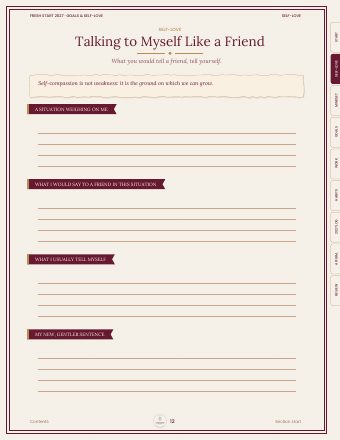
My Journal for a Fresh Start 2027 has a whole section on self-love and mindset: self-compassion, boundaries and confidence. You move toward your goals without beating yourself up along the way.
If you'd prefer a small daily ritual, Every Day, Thank You invites you, morning and evening, to notice what's going well, including in yourself: your effort, your patience, your courage.
When your inner voice hurts too much
For some people, self-criticism is so loud it takes over: shame, feeling worthless, dark thoughts. Self-compassion can help, but it doesn't replace real support. Talking with a psychologist, your doctor or a support line is a true act of kindness toward yourself.
Frequently asked questions
Does self-compassion make you lazy?
No. The Breines and Chen experiments (2012) suggest the opposite: after a mistake, people who treated themselves with compassion were more motivated to improve, and even studied longer after failing a test.
What's the difference between self-compassion and self-esteem?
Self-esteem often rests on being "good" or better than others, and it can crash after a failure. Self-compassion doesn't depend on results; it shows up precisely when things go wrong.
How do I start if I can't do it at all?
Start small. Once a day, when you catch a harsh thought about yourself, ask: "Would I say this to a friend?" If not, look for what you would say to her instead.
Can I teach self-compassion to my kids?
Yes, mostly by example. When you make a mistake in front of them, say out loud: "Oops, I got that wrong. That's okay, I'll try again." They learn that a mistake isn't a disaster.
Sources
- Kristin Neff, Self-Compassion: Exercise 1, How would you treat a friend?
- University of Illinois Extension: Self-compassion
- Harvard Health Publishing: 4 ways to boost your self-compassion
- PubMed: Self-compassion increases self-improvement motivation (Breines & Chen, 2012)
This article is written with the help of artificial intelligence and reviewed by the Lantern Days team. It does not replace advice from a professional. See our Artificial intelligence page.
To go further



Subscribe and get 2 gifts


