
How to Set Realistic Goals for 2027 (and Actually Reach Them)
A simple 7-step method to choose your 2027 goals, break them into small actions and stay motivated all year, with self-love and without judging yourself.
Published on November 10, 2026 · 4 min read

To set realistic goals for 2027, start by reviewing 2026, choose three to six goals that truly matter to you, break each one into small concrete actions and schedule a monthly check-in to adjust your plan. A realistic goal isn't a small goal: it's a goal that respects your energy, your time and your life as it really is.
Here is a gentle 7-step method, the same one we use in our Fresh Start 2027 journal.
Step 1: Review 2026 before looking at 2027
It's tempting to jump straight to new resolutions. Yet looking back at the year that's ending is what makes goals realistic. Take an hour and a cup of tea, and answer these questions:
- What am I proud of this year, even if it's small?
- What took the most energy out of me?
- What did I start and abandon, and why?
- What do I want to leave behind?
This review shows you your real limits (time, energy, the unexpected) and what genuinely makes you want to move forward.
Step 2: Look at every area of your life
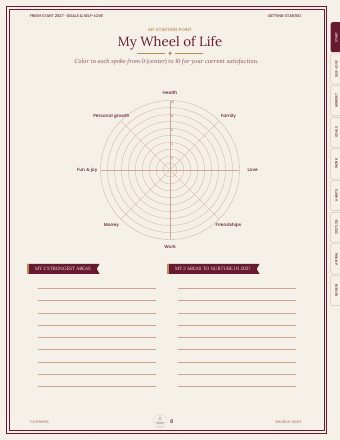
A simple tool to see clearly is the wheel of life. Draw a circle divided into eight slices: health, relationships, family, work, finances, leisure, personal growth and environment (your home and surroundings). Rate your satisfaction in each area from 1 to 10.
The lowest areas aren't necessarily the ones to work on first. Ask yourself instead: "Which one, if it improved, would have a positive effect on the others?"
Step 3: Choose fewer goals
This is the hardest and most important step. Resolutions are often abandoned because there are too many of them. Choose three to six key goals for the year. For each one, ask:
- Why does this matter to me, not just to others?
- What will my life look like when I reach it?
- Am I willing to give it time every week?
If the answer to the last question is no, keep the idea for later. That's not failure, it's a choice.
Step 4: Make each goal clear and measurable
A vague goal ("get in better shape") is hard to track. A clear goal says what, how much and by when. For example:
- "Walk 30 minutes, 4 times a week, by the end of March."
- "Put $50 aside every week for an emergency fund."
- "Read one book a month."
You may have heard of SMART goals (specific, measurable, achievable, relevant, time-bound). This is exactly that, said more simply.
Step 5: Break it into quarters and 90 days
A year is long. Break each goal into four quarters, then focus on the next 90 days. Three months is long enough to see results and short enough to stay motivated.
For each goal, write down:
- what you want to have achieved by the end of the quarter;
- the first three actions to take this month;
- this week's action, as small as possible.
A goal becomes real when its next step is so small you can't say no.
Step 6: Build habits, not just goals
Goals set the direction; habits move you forward. Pair each goal with a simple habit: write for 10 minutes in the morning, prep lunches on Sunday, check your budget every Friday.
To make a habit stick:
- attach it to something you already do ("after my coffee, I…");
- start small, really small;
- check it off in a habit tracker: watching the boxes fill up is very motivating.
Step 7: Do a gentle monthly review
The monthly review is what separates goals abandoned in February from the ones that last all year. Once a month, take 20 minutes to ask yourself:
- What worked well?
- What got in the way?
- What will I change next month?
If you've fallen behind, that's okay. A goal can change along the way. What matters is to keep moving in the right direction, at your own pace.
Where does self-love fit in?
Goals set out of fear or guilt ("I should," "I have to") run out of steam quickly. Goals that come from a desire to take care of yourself last longer. Before you commit to your goals, ask: "Do I speak to myself kindly when I think about this goal?"
Plan for rewards, breaks and moments to celebrate small wins. Moving slowly is still moving.
A simple example to get you started
Say your goal is "feel calmer at home." Made clear, it becomes "spend 15 minutes tidying and 10 minutes journaling every evening, five days a week, until the end of March." Your first 90 days focus on building those two habits. This week's action is tiny: choose where your journal will live and set a reminder on your phone for 8:30 p.m. At your monthly review, you check how many evenings you managed, what got in the way (late work, kids' bedtime) and adjust the time or the length. Small, clear, kind: that's a realistic goal.
Frequently asked questions
How many goals should I have for 2027?
Three to six key goals is a good starting point. With fewer goals, you have more energy for each one and a better chance of reaching them.
When should I start planning 2027?
Right now, if you feel like it. Reviewing your year in November or December lets you arrive in January with a clear plan instead of deciding everything at the last minute.
What if I give up on a goal partway through the year?
Do a quick review: was it too big, too vague, or no longer important to you? You can shrink it, postpone it or replace it. Changing a goal isn't failure.
Does a goals journal really help?
Writing down your goals and tracking your progress makes them more concrete and easier to keep in mind. A guided journal also saves you from starting with a blank page.
Sources
- Harvard Gazette: A step-by-step guide to choose, make and keep New Year's resolutions
- Harvard Extension School: How to create an action plan to achieve your goals
- American Psychological Association: Making lifestyle changes that last
This article is written with the help of artificial intelligence and reviewed by the Lantern Days team. It does not replace advice from a professional. See our Artificial intelligence page.



Subscribe and get 2 gifts


