
How to Write a Letter to Someone Who Died: A Gentle Guide With Prompts
Writing a letter to a loved one who died can help you say what was left unsaid. How to start, what to write, 20 prompts, and what to do with the letter after.
Published on November 11, 2026 · 6 min read

To write a letter to someone who died, find a quiet moment, start with their name, and write what you wish you could tell them, without worrying about writing well. You can tell them about your day, thank them, apologize, say how much you miss them, or let out your anger. There is no right length and no right way. The letter is for you, and nobody else ever needs to read it.
Grief counselors often call this an "unsent letter." It lets you pick up the conversation where it stopped. Below you'll find a simple step-by-step approach, plus prompts for the moments when the page stays blank.
Why write to someone who is no longer here?
When someone dies, the relationship doesn't end all at once. There are still things to say, questions, memories that keep coming back. Many people feel alone with those words because friends and family don't bring the person up, or because they're afraid of being a burden.
Writing gives those words somewhere to go. Psychologists who study expressive writing, including James Pennebaker, have found that putting a painful experience into words often helps people make sense of it. The same research comes with an honest caveat: writing can stir up difficult feelings at first, and it isn't the right tool for everyone. So think of it as a door you can open if it calls to you, not an assignment.
Many grief professionals also talk about continuing bonds. You don't have to "let go" of the person you love in order to heal. Instead, you learn to carry the connection in a new way. A letter is one of the most concrete ways to keep that bond alive.
Before you start: a few tips
- Pick a time when you won't feel rushed. Twenty minutes is enough. A quiet evening, a Sunday morning, or a date that matters to you.
- Plan something comforting for afterward: a warm drink, a blanket, a short walk, a call to a friend.
- Write by hand if you can. Many people find that a pen slows their thoughts down and makes the moment feel more personal. A note on your phone or tablet works just as well, though.
- Don't reread while you write. Spelling, repetition and unfinished sentences don't matter here.
- Let the feelings come. Crying while you write is normal. You can stop and come back later.
If you don't have nice paper at home, a notebook set aside only for these letters can become something you treasure. A pen that feels good in your hand also helps writing become a small ritual instead of a chore.
A simple structure for your letter (if you want one)
You can write freely. But if you're not sure where to begin, try these five parts.
1. Greet them
Start the way you used to: "Dear Mom," "Hey, buddy," "Hi Grandpa." Using the nickname you had for them makes the letter feel real.
2. Tell them what's happening with you
Share what life has been like since they died: what has changed, what's hard, what made you smile. "Since you've been gone, I..."
3. Share a memory
Choose one specific moment: a smell, a song, something they always said. Describe it in detail. Once it's written down, that memory is safe.
4. Say what was left unsaid
This is often the heart of the letter: a thank-you you never got to say, an apology, anger, a question with no answer. You're allowed to write hard things. A letter can hold love and anger at the same time.
5. Close in your own way
A promise, a goodbye, a "see you," or simply "I love you." Some people like to end with how they plan to honor the person going forward.
20 prompts to help you get started
When you're stuck, pick a sentence and let your hand keep going:
- Today I thought of you when...
- What I miss most is...
- I never got the chance to tell you...
- Thank you for teaching me...
- I forgive you for...
- I hope you can forgive me for...
- If you were here, I'd tell you about...
- I'm still angry because...
- My favorite memory of you is...
- I still laugh when I think about...
- Since you died, I've learned that...
- I wish I could ask you...
- The most precious thing you left me is...
- The kids (or the family) are doing okay. They...
- I kept your...
- On the day you died, I wanted to...
- I see you in...
- I keep doing ... for you.
- I don't know how to live without you yet, but...
- What I want you to know is...
Writing a reply "from" them
Some people like to take one more step: after writing their letter, they write the reply they imagine their loved one would send. "Sweetheart, I'm so proud of you..." It can feel strange at first, but it sometimes lets you hear, in your own voice, the gentle words you need. Only do it if it feels right to you.
What to do with the letter once it's written
There's no rule. A few ideas:
- keep it in a notebook, a memory box or with their photos;
- read it out loud, alone or with someone you trust;
- leave it at the grave, the columbarium or a place you both loved;
- write one every year on their birthday or the anniversary of their death, and notice how far you've come;
- share it with someone grieving the same person, if you both want to.
Some people choose to burn or bury their letter as a ritual. If you burn it, do it safely, outdoors and away from anything that could catch fire.
If writing starts to feel too heavy
Writing can bring a lot to the surface. If, after a few letters, you feel worse than before, if you can't sleep or eat, or if sadness keeps you from getting through your days, talk to someone you trust or to a professional. Asking for help isn't failing. It's a way of taking care of yourself.
A journal to keep the conversation going
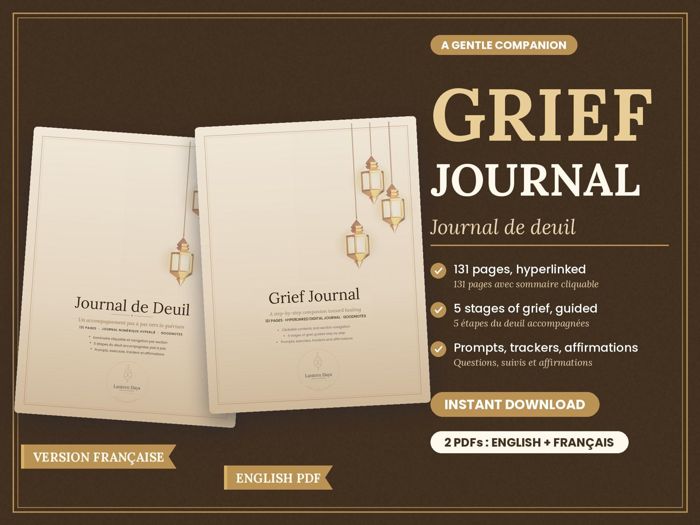
One letter can do a lot of good. But many grieving people want to come back to the page week after week. A guided journal gives you pages for writing to your loved one, gentle questions for the days you don't know what to say, and space to keep your memories. Stone & Light walks with you through your whole first year, one day at a time.
Frequently asked questions
Is it weird to write a letter to someone who died?
Not at all. It's a common exercise, often suggested in grief support groups. Writing to someone who has died is a way to continue the relationship and say what couldn't be said.
How soon after a death can I write a letter?
Whenever you want. Some people write in the first days, others months or years later. It's never too late.
What if I'm angry at the person who died?
Write that down. Anger is part of grief, especially when the relationship was complicated. Your letter can hold both blame and love. No one will judge it.
Can I write a letter to a pet who died?
Yes. Losing a pet is real grief, and a letter can help in the same way: thanking them, sharing memories, saying goodbye.
Sources
- American Psychological Association: Writing to heal
- Canadian Psychological Association: "Psychology Works" Fact Sheet: Grief in Adults
- Cleveland Clinic: What is grief? Types, symptoms and how to cope
This article is written with the help of artificial intelligence and reviewed by the Lantern Days team. It does not replace advice from a professional. See our Artificial intelligence page.
To go further


Subscribe and get 2 gifts


