
Pregnancy Journal Ideas: Pages and Prompts for Every Trimester
What to write in a pregnancy journal: page ideas, prompts for each trimester, letters to your baby and gentle tips to keep journaling without pressure.
Published on November 11, 2026 · 5 min read

You're expecting a baby and want to remember these months? A pregnancy journal is simply a notebook, paper or digital, where you write down what you're living, feeling and want to remember: the first kicks, your cravings, your questions, a letter to your baby. You don't have to write every day, and you don't have to write well. Below you'll find page ideas and prompts, trimester by trimester, to help you start.
Why keep a pregnancy journal?
Pregnancy months feel slow and fast at the same time. So many small moments fade: the day you found out, the first ultrasound, the name you almost picked. A journal holds on to them.
Writing also helps you sort through what you're feeling. A therapist at the University of Rochester Medical Center explains that the benefits of journaling come mostly from the process: putting emotions into words helps you understand them and gain some distance. There are no rules, no right way and no required frequency. That's exactly the spirit to keep during pregnancy, a season when you already have plenty of things to "get right."
And later, this notebook becomes a gift: a keepsake to reread, or to hand to your child one day.
Paper or digital?
Both work. Paper is lovely in the evening, away from screens, and leaves you a beautiful object to keep. Digital (on a tablet, in an app like GoodNotes) makes it easy to add ultrasound photos and fix anything. Pick the format you'll actually want to open.
The core pages of your journal
A few pages to set up at the start and fill in as the months go by:
- The news: how you found out, where you were, what you felt.
- The first people you told and how they reacted.
- Your bump month by month: a photo or a small sketch, always in the same spot.
- Appointments: dates, what you learned, questions for next time.
- Cravings and aversions of the moment.
- The name list: the ones you love, the ones you crossed off (and why).
- Firsts: first heartbeat you heard, first movements, first outfit you bought.
- The soundtrack: music, books and shows of your pregnancy.
- What was happening in the world that year.
- Getting ready: the nursery, the hospital bag, the little gifts you received.
First trimester prompts
Often a time of fatigue, nausea and secrecy. A few gentle questions:
- What did I feel when I saw the test?
- What makes me happy about this news? What worries me?
- Who do I want to tell first, and how?
- What helps me get through the harder days?
- What picture do I have of this baby, for now?
- What do I want to remember about this season, even if it's uncomfortable?
Second trimester prompts
For many, this is when the bump shows and the baby starts to feel more "real."
- How did I experience the first time I felt my baby move?
- What's changing in my body, and how do I feel about it?
- Which family traditions do I want to pass on?
- What kind of parent do I want to be? What do I want to do differently?
- What do my partner or loved ones say about this pregnancy?
- Three things I'm grateful for this week.
Third trimester prompts
A time of preparing, waiting and sometimes worrying.
- How do I picture the birth? What do I hope for, and what scares me?
- What did I pack in my hospital bag, and why?
- What will I need in the first weeks, and who can help?
- What would I like to say to the woman I was before this pregnancy?
- What do I want to remember about these last days when it's just the two of us?
- My list of small comforts for the waiting days.
Writing a letter to your baby
This is often the most treasured page. Write one, or one per trimester. Some ways to begin:
- "The day I learned you existed…"
- "Here's what I hope for you…"
- "Here's the family you're about to join…"
- "What I can't wait to show you…"
- "What I promise you…"
Write the way you talk. Your child won't be reading a perfect text; they'll be hearing your voice.
Keeping it going without pressure
- Write when you feel like it, even once a month. A journal with gaps is still a treasure.
- One sentence is enough. "Today you kicked during the song on the radio."
- Keep it within reach: on your nightstand, in your bag or on your tablet.
- Mix formats: lists, photos, appointment cards, doodles.
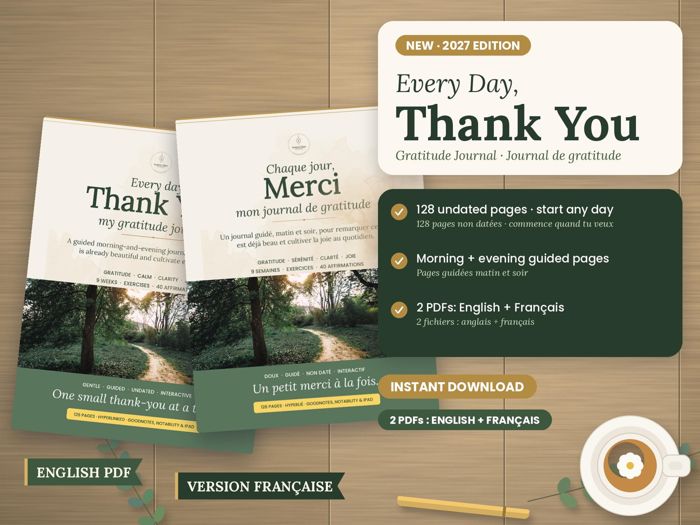
- Add one thank-you a day if you like the idea: noticing good things can help on the heavier days.
For that daily thank-you, our gratitude journal can keep you company during pregnancy and after:
When your journal shows something is wrong
A journal can also show you that you're carrying something heavier. The U.S. National Institute of Mental Health (NIMH) notes that perinatal depression can begin during pregnancy, not only after birth. Sadness, anxiety or emptiness that won't lift, losing interest in things, hopelessness or guilt are worth raising with your health care provider. It's treatable, and you don't have to wait it out alone. In the U.S., the National Maternal Mental Health Hotline is available at 1-833-852-6262. If you have thoughts of harming yourself, get help right away.
Frequently asked questions
When should I start a pregnancy journal?
Whenever you want. Some start with the positive test, others in the second trimester. You can always write about the early moments afterward, from memory.
What should I write in a pregnancy journal if I have no ideas?
Answer one question: "What do I want to remember about this week?" Or jot down three small things: a symptom, a feeling, a thank-you.
Do I need to write every day?
No. There's no required frequency. One page a week or a month already makes a lovely keepsake.
Can partners keep a pregnancy journal together?
Yes. Your partner can write their own pages, or you can each answer the same prompts and read them together.
Sources
- University of Rochester Medical Center: No Rules, Just Write: A New Approach to Journaling
- National Institute of Mental Health: Perinatal Depression
This article is written with the help of artificial intelligence and reviewed by the Lantern Days team. It does not replace advice from a professional. See our Artificial intelligence page.
Subscribe and get 2 gifts


