
The Wheel of Life Exercise: Check In on the 8 Areas of Your Life
What is the wheel of life and how do you use it? The 8 life areas, how to rate them from 0 to 10, questions to ask yourself and how to choose where to start.
Published on November 11, 2026 · 6 min read

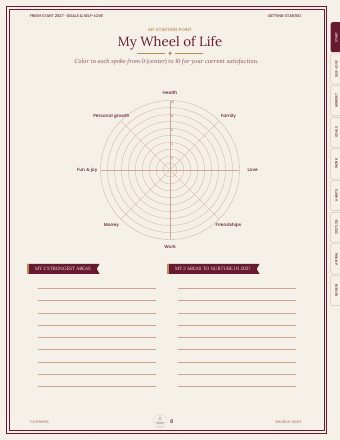
The wheel of life is a simple exercise that helps you check in on your whole life in just a few minutes. You draw a circle divided into eight slices (such as health, family, career, money and fun), rate your satisfaction with each one from 0 to 10, then connect the dots: the shape you get shows you at a glance where you feel good and where you need some attention. Here's how to do it, which questions to ask yourself, and how to decide where to start.
Where the wheel of life comes from
The wheel of life is a widely used coaching tool. It's featured in Co-Active Coaching, a well-known book by Henry Kimsey-House, Karen Kimsey-House and Phillip Sandahl, and it forms the basis of exercises shared by universities such as Texas A&M. The idea is simple: instead of thinking about your life as one big blur, you break it into pieces that are easier to look at.
One important point: the wheel is a snapshot of how satisfied you feel today, not a report card or a verdict on your past. The goal isn't to score 10 everywhere. The goal is for your "wheel" to roll a little more smoothly.
The 8 classic life areas
Here are the eight areas most often used:
- Physical environment: your home, your neighborhood, the space you live in.
- Career or occupation: your work, your studies, your everyday role.
- Family and friends: your connections with the people close to you.
- Partner or romance: your relationship, or how you experience your love life if you're single.
- Personal growth: learning, growing, discovering yourself.
- Money: your relationship with your finances and your sense of security.
- Health: your energy, your sleep, your body.
- Fun and recreation: play, rest, whatever feels good just because you enjoy it.
You can rename, merge or add categories. Some people swap "Romance" for "Me," add "Spirituality," or split "Kids" and "Friends." It's your wheel: it should reflect your life.
How to do the wheel of life in 5 steps
1. Draw your wheel
Draw a large circle and divide it into eight slices, like a pizza. Write the name of one area in each slice. The center is 0 and the outer edge is 10.
2. Rate each area
For each area, ask yourself: "How satisfied am I with this part of my life right now?" Rate it from 0 (not at all satisfied) to 10 (very satisfied). Go quickly and trust your first instinct. There are no right answers.
3. Connect the dots
Mark a dot on each spoke at the level of your score, then connect the dots. You'll get a shape inside your circle. Color it in if you like.
4. Look at the shape
Coaches often use a helpful image here: if this wheel were a tire on your car, would the ride be smooth or bumpy? Write down what you notice. An area that's very low? One that's higher than you expected? An imbalance between two areas?
5. Choose just one area
This is the most important step. Don't try to improve everything at once. Pick the area you most want to change, or the one where a small shift would make the biggest difference. It isn't always the lowest score.
Wheel of life questions to ask yourself
Once you've picked your area, take a few minutes to write down your answers:
- Why did I give it this score? What's already working?
- What would a 10 look like for me, in real life?
- What would raise my score by one or two points?
- What's one first action I can take this week?
- What might get in my way, and how can I prepare for it?
- How will I know I'm making progress?
Keep the bar low: going from a 4 to a 6 is a real win.
Why one change at a time works better
The American Psychological Association puts it plainly: trying to change too much at once often leads to giving up. It recommends focusing on one change, breaking it into small, measurable steps, and adding a new goal once the first has become a habit. It also suggests finding someone to cheer you on and being kind to yourself after a slip.
The wheel of life fits that advice perfectly: it helps you choose where to put your energy so you don't spread yourself too thin.
Redo your wheel throughout the year
The wheel of life gets even more useful when you repeat it. Every three months, for example, or at the start of each season. Compare your wheels:
- Which areas went up?
- Which went down, and why?
- Did the area you chose move? Should you keep going or pick a new one?
It's normal for some areas to dip while you're working on others. A busy season at work, a loss or a new baby can shift your whole balance. The wheel simply helps you see it, without judgment.
Your wheel of life in your journal
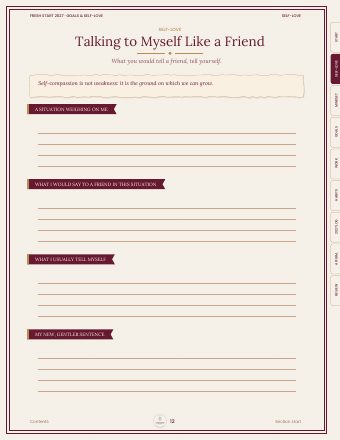
Our Fresh Start 2027 journal opens with a 2026 review and a wheel of life page, followed by your values and your word of the year. It then helps you turn what you noticed in your wheel into key goals, quarterly plans and monthly check-ins. You can redo your wheel every quarter and see your progress in one place.
Doing the wheel of life as a couple or with kids
You can also invite your partner to try it: each of you fills in your own wheel, then you compare them with curiosity, without debating the scores. It's a lovely way to understand what the other person is going through.
With older kids, you can simplify the wheel into six easy areas: school, friends, family, play, body and sleep, feelings. Their answers often open up great conversations.
Frequently asked questions
What is the wheel of life?
It's a coaching exercise that divides your life into areas (often eight) that you rate from 0 to 10 based on how satisfied you feel. The resulting shape quickly shows which areas feel balanced and which need attention.
What are the 8 areas of the wheel of life?
The most common ones are physical environment, career, family and friends, partner or romance, personal growth, money, health, and fun and recreation. You can adapt them to your life, for example by adding spirituality or a space just for you.
Should I aim for a 10 in every area?
No. The wheel isn't a test. The goal is a better balance for you, not perfection in every area. A rounder wheel, even with middle scores, often rolls better than one with a few 10s and a few 2s.
How often should I do the wheel of life?
Every three months is a good rhythm, or as part of your end-of-year reflection. Repeating it regularly helps you see your progress and adjust your priorities.
Sources
- Texas A&M University: Module 3 Wheel of Life Exercise (PDF)
- American Psychological Association: Making lifestyle changes that last
This article is written with the help of artificial intelligence and reviewed by the Lantern Days team. It does not replace advice from a professional. See our Artificial intelligence page.


Subscribe and get 2 gifts


